Most people who wear a sterling silver pendant never think about what went into making it. But the decisions made during the production process how the bail is constructed, how the stone is set, how the surface is finished are exactly what separates a pendant that lasts a decade from one that shows wear within a year. Understanding how to make sterling silver pendants at a professional level, and what each stage produces, changes what you look for when you buy.
What Sterling Silver Pendants Are Made From
The first thing to understand about how to make silver pendants professionally is the material itself, because it determines everything that follows. Sterling silver, marked with the 925 hallmark, contains 92.5% pure silver and 7.5% copper. Pure silver at 999 fineness is too soft for pendants worn daily it bends at the bail, scratches easily across the face, and loses its shape under normal contact. The copper addition provides the structural hardness needed without affecting the appearance or tarnish behaviour of the metal.
For pendants specifically, the solid vs. plated distinction is more consequential than it is for rings. A plated pendant wears through most quickly at the bail, which is the point of highest friction against the chain. Every movement the wearer makes creates rotation or tension at the bail connection. Solid 925 sterling silver throughout means the bail is as durable as the pendant face the weakest point in a plated pendant becomes a non-issue in a solid one. The 925 stamp inside the bail loop or on the reverse of the pendant confirms this.
For more on why solid 925 silver tarnishes naturally and what that confirms about the material, read our guide on does sterling silver tarnish.

How Sterling Silver Pendants Are Designed
Design is the stage that determines how the finished pendant will hang, how it will look in motion, and how long it will hold its character. Pendant design involves a set of considerations that ring design does not, and getting these right before any metal is cut saves significant rework at every subsequent stage.
Pendant-Specific Design Considerations
A ring is a circular form with consistent stress distribution around the band. A pendant is a flat or semi-three-dimensional form that must hang correctly from a single attachment point. The design must account for four things that ring design does not require:
• Centre of gravity: the pendant must hang without tilting to either side. An asymmetric form needs the bail positioned off-centre to compensate.
• Bail placement: the bail should sit in the top third of the pendant, not at the dead edge. This prevents the pendant from flipping face-backwards on the chain.
• Visual balance on both faces: unlike a ring, a pendant is seen from the front in daily wear but handled on both sides when put on, taken off, or gifted. Both faces must be considered.
• How the design reads at distance: pendants are seen from 30 to 60cm as the wearer moves. Fine detail that reads well in a photograph can disappear entirely in wear.
From Sketch to CAD
At NineTwoFive, every pendant begins as a hand-drawn sketch in the Netherlands studio, guided by the same architectural principles that shape every piece in the collection: clean geometry, precise proportion, balanced negative space. The sketch is converted into a CAD model that allows the design team to test the centre of gravity, check wall thicknesses, and simulate how the pendant will hang before any silver is involved. The CAD file also serves as the technical instruction set for the Balinese silversmiths who produce each piece.
For more on the architectural design philosophy behind NineTwoFive's pendant range, read our source of inspiration.

Two Ways to Make a Sterling Silver Pendant: Casting vs. Fabrication
Understanding how to make sterling silver pendants requires understanding the two routes available to bring the design into physical form. The choice depends on the complexity of the design, the volume being produced, and the specific characteristics the finished pendant needs.

Most quality production pendants combine both approaches: lost wax casting provides the precise form, and hand finishing delivers the surface quality that defines the finished piece. The casting stage is where the design is realised; the finishing stage is where the character of the piece emerges. NineTwoFive's Art Deco pendant range uses casting for the layered geometric form and hand finishing by Balinese artisans for the surface.
Lost Wax Casting: How It Works for Pendants
A wax model of the pendant is produced, either carved by hand or generated from a 3D-printed resin prototype derived from the CAD file. The wax is encased in an investment mould, fired in a kiln to burn out the wax completely, and molten 925 sterling silver is then poured or centrifugally cast into the resulting cavity. Once cooled, the pendant is removed from the mould at the sprue point and the real work of finishing begins. The pendant at this stage will show casting texture across its surface and will need significant progressive refinement before it is ready to wear.
The same casting and hand-finishing approach applies across NineTwoFive's full range of solid silver pieces. For more on how this process shapes men's rings specifically, read our silver ring for men guide.
The Bail: The Most Critical Element of a Sterling Silver Pendant
The bail is the loop or fitting at the top of the pendant through which the chain passes. It is the smallest component of the piece and, structurally, the most important. Every time the wearer moves, the bail rotates against the chain, bears friction, and absorbs tension. A pendant worn every day for a year makes this contact hundreds of thousands of times. The quality of the bail determines whether the pendant is still intact at the end of that period.
Types of Bail and What They Mean for Durability
There are three main bail constructions, and each produces a different outcome for long-term wear:
• Solid tube bail (drilled and soldered): the strongest construction. A section of solid silver tube is soldered to the top of the pendant. The tube wall is thick enough to resist thinning under daily friction. The solder join, when executed correctly, is as strong as the surrounding metal.
• Loop bail (wire bent into loop): adequate for occasional wear but thins faster under daily friction. The wire cross-section is small to begin with, and abrasion from the chain reduces it further over time. The bend point is also a stress concentration.
• Integrated bail (cast as part of pendant body): the most structurally sound option because there is no separate join point. The bail and pendant are one continuous piece of metal. NineTwoFive pendants use a bail with a 5mm loop diameter, compatible with all box chain sizes in the collection.
The practical check when buying: press the bail gently between finger and thumb. A solid tube bail will not deform. A thin wire loop will flex noticeably. This single test tells you more about the pendant's longevity than any finish quality assessment.
NineTwoFive pendants use a 5mm bail loop, compatible with the full range of chain sizes in the collection. To find your ideal chain length and width, use our men's chain size chart.

Setting Stones in Silver Pendants
Stone setting in pendants is technically different from ring setting because gravity acts differently on a pendant face. A ring stone is set horizontally and held in place by the setting under constant downward pressure. A pendant stone is set vertically in daily wear the stone faces forward and must be held securely against both lateral movement and the occasional forward knock. This means pendant stone settings are typically tighter than equivalent ring settings.
Bezel Setting for Pendants
Bezel setting surrounds the stone with a continuous rim of silver that is pressed over the edge of the stone to hold it in place. It is the most secure setting for a pendant worn daily because the stone is fully enclosed on all sides, making it resistant to both lateral movement and forward impact. The height of the bezel must be calibrated precisely: too high and the bezel wall covers the character of the stone; too low and the rim cannot generate enough grip to hold securely under movement.
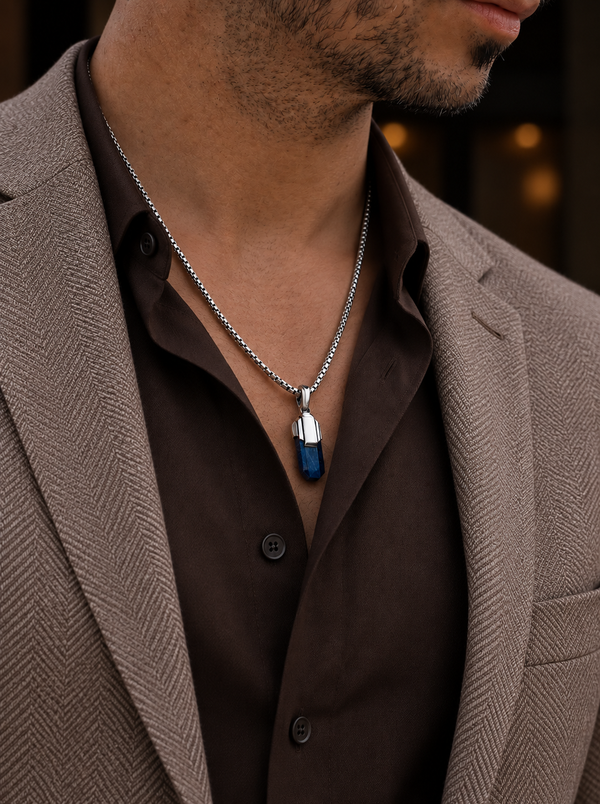
NineTwoFive's stone-set pendants use bezel settings in which the silver frame becomes part of the design geometry rather than a functional afterthought. In the Tahsin (Black Onyx) and Tahrir (Blue Pietersite), the bezel sits within an Art Deco layered structure that frames the stone as the visual focal point of the pendant face. The setting and the design are resolved together, not separately.
For more on how stone-set pendants and chains fit into current men's silver jewellery, read our guide on men's silver jewellery trends.
Shop now: Men's Silver Pendants
Filing, Finishing, and the Two-Sided Challenge
Finishing is the stage that takes the pendant from a functionally complete casting to a piece ready to wear. It is also where most of the time is spent, and where the visible quality of the piece is established. The process moves through progressively finer abrasives, removing the marks from each previous stage until the surface is ready for its final treatment.

The abrasive sequence for a pendant face typically runs:
• Coarse files to remove casting sprue and major surface irregularities
• 220 grit sandpaper to remove file marks
• 400 and 600 grit to refine the surface further
• 800 to 1200 grit to prepare for polishing compound
• Polishing compound on a soft cloth or buffing wheel for the final surface
The pendant-specific challenge at this stage is that both faces require the same level of attention. The front face is the one seen in daily wear. The back face is the one handled when the pendant is put on, taken off, examined by a potential buyer, or engraved. A piece where the back is left rough or uneven while the front is polished to a mirror finish reveals that the silversmith treated the pendant as a display object rather than a wearable one.
Engraving as the Final Finishing Stage
Engraving on a pendant is applied after all other finishing is complete. Laser engraving, which NineTwoFive uses across all pendant types, is applied to the fully polished back face. The laser removes material precisely without heat distortion, which means the surrounding surface is not affected by the engraving process. The engraved text or symbol sits cleanly against the polished silver because the surface was brought to its final quality before the laser touched it.
For guidance on maintaining your pendant and chain in daily wear, including how to clean silver safely at home, read our guide on how to clean a silver chain.
What the Making Process Means for the Pendant You Wear
Understanding how sterling silver pendants are made changes what to look for when choosing one. Every quality indicator that matters to a buyer corresponds directly to a stage in the making process. The table below maps the checklist to the craftsmanship behind it.

Each point on the checklist reflects a specific stage in making the pendant: the hallmark confirms material at the source; the bail quality reflects the construction stage; the surface consistency reflects the filing and finishing work; and the stone security reflects the precision of the bezel calibration. A pendant that passes all six checks has been made with care at every stage, not just the stage visible from the front.
For guidance on choosing the right chain length and style to pair with your pendant, read our men's chain layering guide.
Frequently Asked Questions
How are sterling silver pendants made?
Quality silver pendants are made through five stages: designing with pendant-specific constraints, casting or fabricating the form, constructing the bail, setting any stones, and finishing through progressive filing and polishing on both faces. Solid 925 sterling silver is used throughout.
What is a bail on a pendant and why does it matter?
The bail is the loop at the top of the pendant through which the chain passes. It bears more friction than any other part of the piece. A solid tube bail lasts significantly longer under daily wear than a thin wire loop, which thins and weakens over time.
How are stones set in silver pendants?
Bezel setting is the most common method for daily-wear pendants. A continuous silver rim is pressed over the stone edge to hold it securely against lateral movement and forward impact. The bezel height must be calibrated precisely so the stone is secure without being obscured.
What does the 925 stamp mean on a pendant?
The 925 hallmark confirms solid sterling silver throughout: 92.5% pure silver and 7.5% copper. It should appear on the pendant reverse or inside the bail loop. A pendant without this mark is either plated or made from a base metal alloy.
How can I tell if a silver pendant is well made before buying?
Press the bail to confirm it is solid, not a thin wire loop. Examine the surface under direct light for consistent finish with no pitting. Check that any stone does not move when pressed. Confirm the reverse face is finished to the same standard as the front.
Craft Is What You Wear Every Day
Sterling silver pendants that last are made with care at every stage: from the design that places the bail correctly to the finishing that treats both faces as equally important. Knowing how to make silver pendants at a professional level does not make buying one more complicated. It makes it clearer. The hallmark, the bail, the surface finish: these are visible evidence of everything that happened in the workshop before the pendant reached you.
Shop now: Pendant and Ring Sets