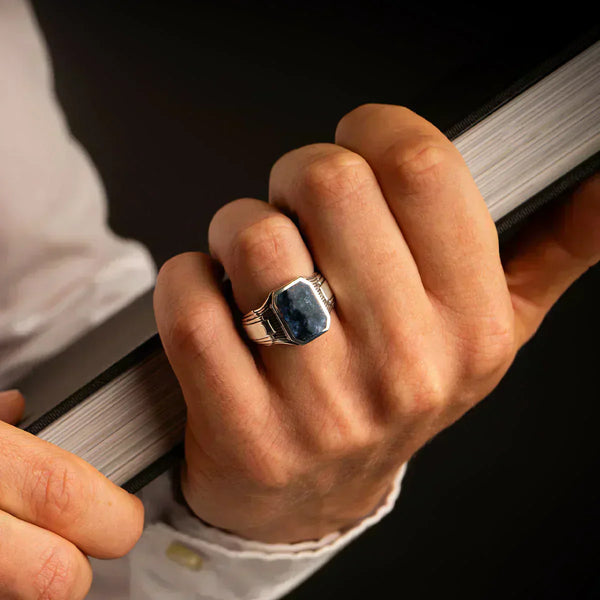
To wear multiple rings well, follow three principles: keep the total to two or three rings as a starting point, vary the width so rings do not compete visually, and anchor the look with one statement piece such as a signet ring. Start with one hand, build outward from a single strong ring, and keep metals consistent across the stack.
How to wear multiple rings is one of the most common jewellery questions men search for, and the anxiety is usually the same: how many is too many, and what makes the difference between a look that reads as considered and one that reads as overdone. The answer is not a strict rule but a framework, and this guide provides exactly that: a clear approach to how to wear multiple rings, which men can apply across any occasion, from a single ring at the office to a full stack at the weekend.

How Many Rings Should a Man Wear?
The most common anxiety about how to wear multiple rings is the number. Most style guides are vague about this, but a specific framework helps: one ring is classic and clean, two rings are balanced and easy, three rings make a considered statement, and four or more require real intention and a clear visual logic to avoid looking overdone. The right number is also context-dependent, which the occasion table later in this guide covers in detail.
The Starting Point: One to Three Rings
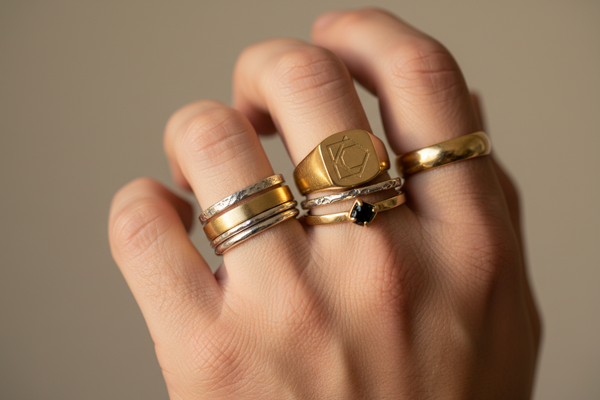
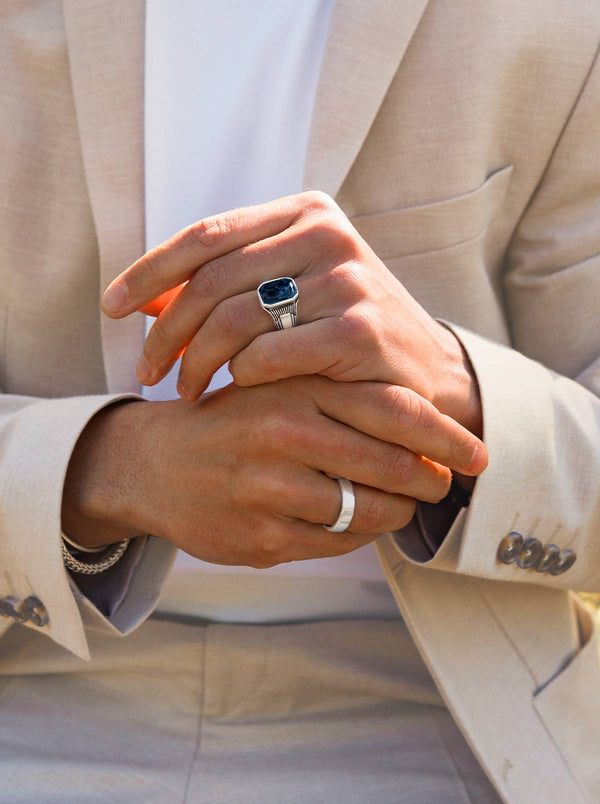
For anyone learning how to wear multiple rings for the first time, starting with two rings on one hand is the most accessible entry point. A single anchor ring on the index finger, such as a signet or a wider plain band, paired with a thinner ring on the same hand's middle or ring finger, creates the core structure that all more complex stacks build on. The anchor ring leads; the accent ring supports without competing. Three rings across both hands is the next step: two on the dominant hand and one on the other, which distributes visual weight without crowding any single hand.
Building From One Ring Outward
The most reliable approach to how to wear multiple rings is to start with the piece you would choose if you could only wear one, then add with that ring as the reference point. Every ring added should either be narrower than the anchor, in a contrasting finish, or on a different finger so that the original piece remains visually dominant. Adding a ring that matches the anchor in width and finish creates competition rather than complement, and that is where most stacks go wrong.
See more: Signet Ring Shapes: Every Style Explained and How to Choose Yours
Which Fingers to Use When Wearing Multiple Rings
Finger placement is the structural logic behind how to wear multiple rings well. Which fingers you use is the most important decision in how to wear multiple rings well, and the logic is simpler than most guides make it seem.
The Anchor Finger
The index finger and little finger are the two strongest anchor positions for a statement ring. Both sit at the visual edges of the hand and draw attention cleanly without interfering with grip or function. The index finger suits larger, bolder rings. The little finger is the traditional signet ring placement and reads as heritage and considered rather than heavy. The middle finger can hold a wider ring but draws less attention than the index, which makes it a better accent position than an anchor position for most men.
Distributing Rings Across Both Hands
Two rings across both hands, one on each, creates natural balance without requiring any thought about spacing. Three rings work best in a two-plus-one split: two on the dominant hand and one on the other. Three rings on one hand is possible but requires careful spacing: adjacent fingers with varied widths work, while every other finger creates awkward visual gaps. Four rings across both hands, two on each, is the maximum for most men without the look becoming the primary point of the outfit.
Which Fingers Work for Which Ring Types
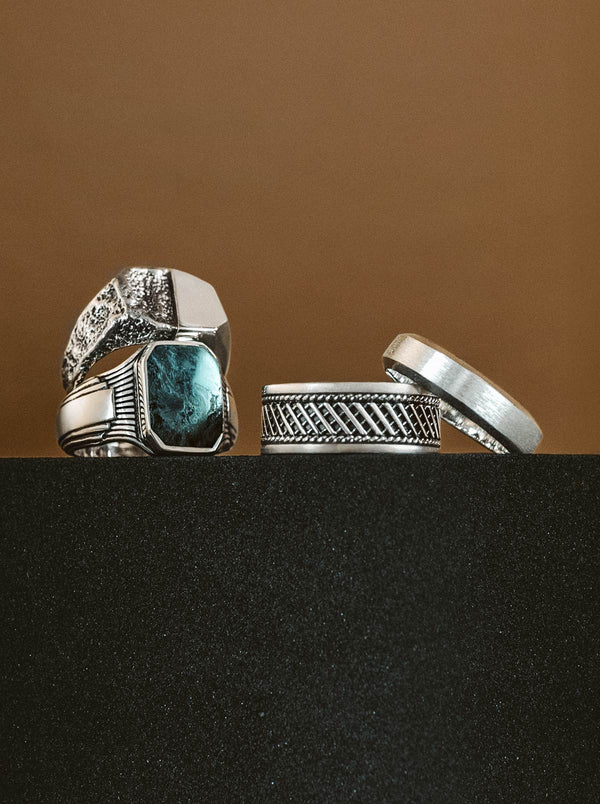
Signet rings, whether plain silver or stone-set, suit the index or little finger almost exclusively. Plain bands in any width sit naturally on the ring or middle finger. Textured or detailed rings, such as oxidised, braided, or architectural styles, read best on the index or middle finger where they have visual space to be seen. Stacking two rings on adjacent fingers works when the rings differ in width by at least 3mm; rings of identical width on adjacent fingers merge visually and read as one heavy band rather than two distinct pieces.
See more: Which Finger for a Signet Ring: The Complete Guide

Ring Types and How to Mix Them
Understanding which ring types sit together well is central to knowing how to wear multiple rings as a man. The key principle is the anchor and accent system: one ring leads and the others support. Choosing rings without this hierarchy is the most common reason a multi-ring look fails to hold together.
The Anchor and Accent Principle
How to wear multiple rings well starts with understanding the anchor ring: the widest, most detailed, or most visually prominent piece in the stack. Anchor rings earn that position through scale, surface detail, or stone setting. Every other ring in the look is an accent: narrower, plainer, or in a contrasting but less dominant finish. A 13mm black onyx signet ring is an anchor. A 6mm plain silver band is an accent. A 5mm braided band is an accent. Two anchors compete; one anchor and two accents create a coherent look.
Mixing Signet, Band, and Stone Rings
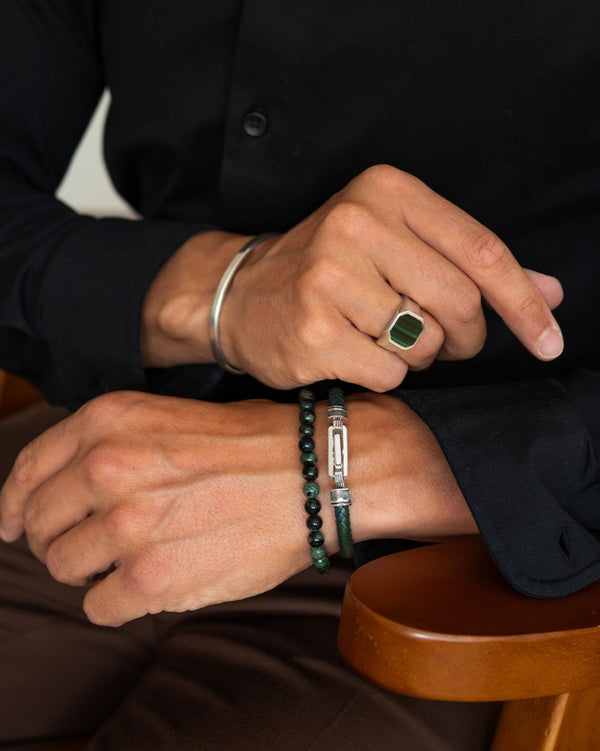
Signet rings function best as anchor pieces when worn with plain or lightly textured bands as accents. A stone-set signet, such as a black onyx or tiger eye signet, brings colour and surface complexity into the stack and benefits from particularly plain accents that let the stone be the focal point. A plain silver signet in a matte finish can be paired with either plain bands or lightly textured rings without creating visual conflict. Avoid pairing two stone-set rings in the same stack unless the stones are the same colour family.
Mixing Metals
The most consistent guidance on metal mixing is to choose one metal and build the stack around it. A fully silver stack reads as unified and deliberate. Mixed silver and gold requires clear intention: a gold accent ring on a silver anchor can work if the difference is treated as a design choice rather than a mismatch. At NineTwoFive, all pieces are crafted in solid 925 sterling silver, which makes the question of metal mixing straightforward: the collection builds cohesive stacks by design, with surface finish variations, oxidised, matt, polished, doing the visual work that metal mixing would do in a mixed-metal wardrobe.
Explore the full range at Men's Signet Rings.
How to Wear Multiple Rings with NineTwoFive Pieces
Applying how to wear multiple rings in practice starts with the right pieces. and a consistent sterling silver palette, which makes the pieces naturally compatible for stacking. The table below shows five specific combinations drawn from the collection, covering a range of occasions and aesthetics. Each uses the anchor and accent principle with rings selected for width contrast and finish compatibility.
The Classic Three-Ring stack uses descending widths on three adjacent fingers of the same hand: the Naim Onyx Signet at 13mm anchors the index, the Malik Plain at 7mm sits on the middle, and the Latif Braided at 5mm closes on the ring finger. Each ring is clearly visible, clearly distinct, and clearly part of the same considered look. The Architectural Stack works differently: the Basel Oxidised and Ferran Oxidised share a surface finish, creating cohesion through finish rather than width, with the Latif Braided breaking the oxidised theme and adding texture contrast.
Browse the full ring collection at Men's Silver Rings.

How Many Rings for Each Occasion
Context determines how to wear multiple rings more than personal preference alone. The table below covers the five most common settings where how to wear multiple rings men need to consider, with specific guidance on number, placement, and what to avoid in each.

The office column is the most important for most wearers: one ring is never wrong in a professional context, and the right one ring, a clean matte signet on the little finger or a plain band on the index, communicates considered style without distraction. The festival and streetwear column represents the maximum for most men; beyond four rings, the jewellery becomes the entire look rather than part of it, which requires a high level of conviction to carry.
Wearing Rings with Bracelets and Watches
Knowing how to wear multiple rings also means knowing how they interact with everything else on the wrist. A man wearing multiple rings is usually also wearing a watch or bracelets, and the interaction between wrist and finger jewellery shapes the overall look as much as the rings themselves.
Rings and Watches on the Same Side
A watch on the left wrist draws significant visual attention, which is worth factoring into how to wear multiple rings when a watch is part of the look. Adding multiple rings to the same hand can create a crowded left side and a bare right side, which reads as unbalanced rather than bold. The cleaner approach when wearing a watch is to move the ring stack to the opposite hand or limit the ring-wearing side to one clean ring. A single signet on the little finger of the watch hand is the traditional pairing and works precisely because it does not compete with the watch.
Rings and Bracelets
The rule when thinking about how to wear multiple rings alongside bracelets is to let one category lead. If wearing multiple bracelets, keep the ring count to one or two across both hands and choose plain or minimal rings that do not draw focus from the wrist. If wearing multiple rings as the primary jewellery statement, keep the wrist minimal: a single thin chain bracelet or nothing at all. Stacking both heavily creates visual noise across the entire hand and wrist area that is difficult to pull back from without removing pieces.
See more: Silver Bracelet for Men 2025: Style and Care Guide

Common Mistakes When Wearing Multiple Rings
Knowing how to wear multiple rings correctly is as much about what to avoid as what to do. The most common errors when starting to stack rings are not about taste but about proportion and visual logic.
Uniform Width Across the Stack
Wearing three rings of identical or near-identical width on adjacent fingers is the single most common mistake. The rings merge visually into one continuous band and lose their individual character. Vary width by at least 3mm between adjacent rings: a 13mm anchor beside a 7mm accent beside a 5mm thin band creates clear visual separation that reads as intentional.
All Statement Pieces, No Accents
Choosing every ring in the stack for its visual impact, a wide oxidised ring alongside a large stone signet alongside a textured architectural band, creates competing focal points and visual chaos. Every stack needs at least one plain or minimal ring that gives the eye a place to rest between the more complex pieces.
Ignoring Hand Proportion
Ring width should relate to hand size. Men with narrower hands or shorter fingers tend to look better in rings up to 10mm wide; wider rings can visually overwhelm a smaller hand. Men with larger hands can carry 13mm and 17mm statement pieces without the ring dominating the hand. NineTwoFive offers most anchor pieces in 7mm and 13mm variants, which is designed around this proportional reality.
See more: Men's Rings Meaning: What Every Finger Says About You

FAQ: How to Wear Multiple Rings Men
How to wear multiple rings without overdoing it: how many is too many?
Four rings across both hands is the maximum for most men in most contexts. Beyond four, the rings become the primary point of the outfit rather than part of it. In a professional setting, one ring is always appropriate; two is usually fine; three requires care. In casual or streetwear settings, three to four with clear width variation and logical placement reads as deliberate rather than excessive.
How to wear multiple rings on both hands: does it work?
Yes, and it is often the better choice than stacking multiple rings on one hand. Distributing rings across both hands creates balance and gives each ring more visual space. Two rings on the dominant hand and one on the other is a reliable three-ring arrangement that avoids crowding any single hand.
How to wear multiple rings on the same finger: is it advisable?
Two rings stacked on the same finger is a specific look that works only with very thin rings, typically under 4mm each. Rings of normal width on the same finger create a single heavy-looking mass rather than two distinct pieces. Wearing rings on adjacent fingers with varied widths is the more practical and more visually effective approach.
How to wear multiple rings when mixing a signet with plain bands?
Yes. A signet ring and a plain band is one of the most classic multi-ring combinations in men's jewellery. The signet functions as the anchor piece and the plain band as the accent. The key is width contrast: the plain band should be noticeably narrower than the signet so that the two rings are clearly distinct rather than competing.
How to wear multiple rings for the first time: what is the best starting combination?
A signet ring on the index or little finger of the dominant hand, paired with a thin plain band on the middle or ring finger of the same hand, is the most accessible two-ring starting point. It introduces the anchor and accent principle without requiring advanced styling knowledge, and it scales naturally to a third ring as confidence increases.
Final Thoughts
Knowing how to wear multiple rings well comes down to one principle applied consistently: anchor, accent, and context. A strong statement ring leads, narrower and plainer rings support, and the total number matches the occasion. The rest is personal. If you are ready to build your own stack, explore the full range of solid 925 sterling silver rings at Men's Rings, crafted for daily wear and built to pair.