Gids voor herenkettingen

Zilveren hangers voor heren

Gids voor herenkettingen

Soorten hangers voor heren: een complete gids voor alle stijlen

door Adam NineTwoFive op 4 augustus 2026
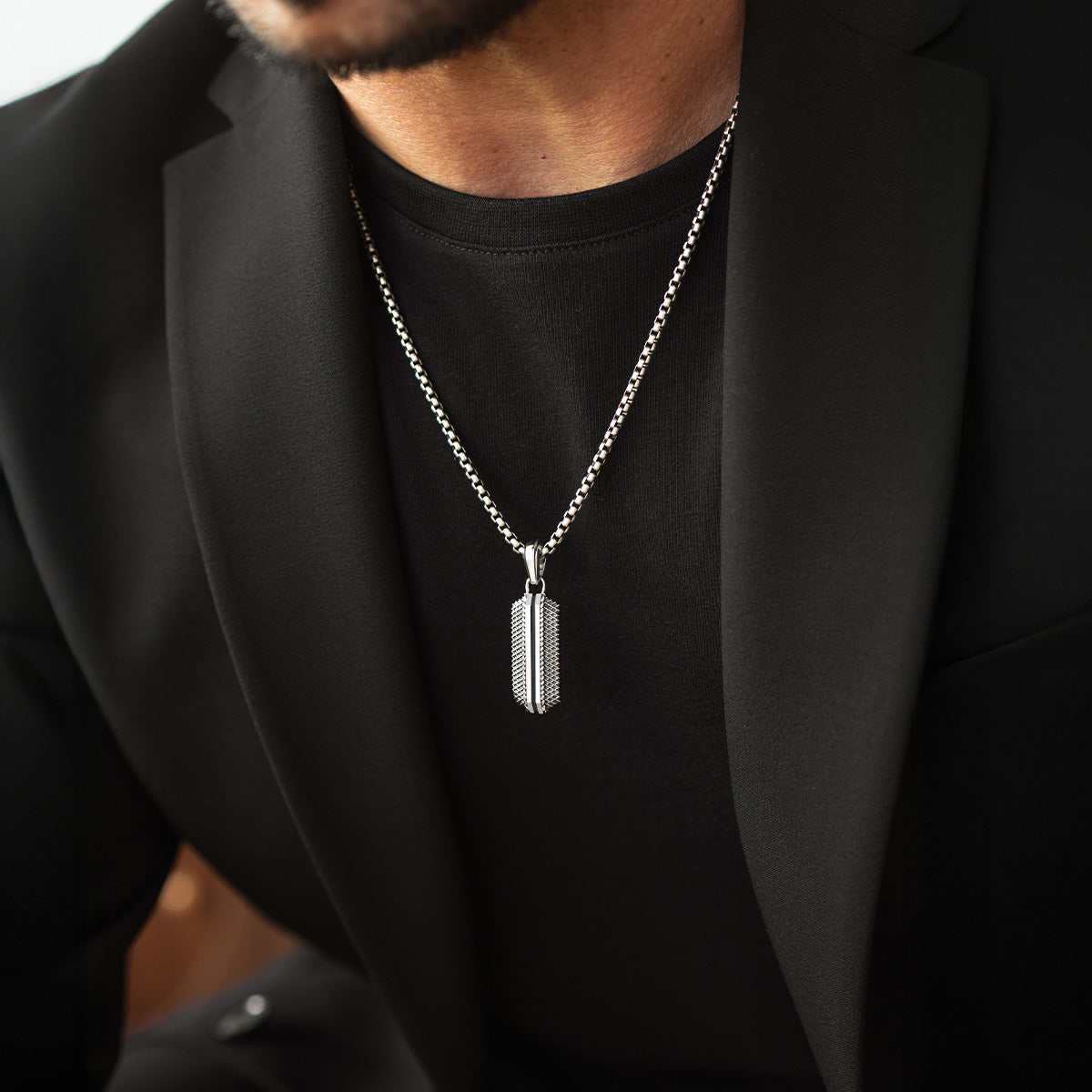
The main types of necklace pendants for men are geometric and architectural pendants, stone-set pendants, symbolic pendants such as anchors and crosses, dog tag and bar pendants, engraved and personalised pendants, religious pendants, and locket pendants. Each type carries a different visual weight and meaning, making the right choice dependent on personal style, wearing context, and intended purpose. This guide covers the key necklace pendant types for men, including what distinguishes each one and when it works best. Types of Necklace Pendants: An Overview Before looking at each type individually, it helps to understand what distinguishes one pendant type from another. The categories below are defined primarily by design language and by the role the pendant plays, rather than by size or material alone. Two pendants can be made from the same solid 925 sterling silver at identical dimensions and still communicate entirely different things about the person wearing them. The overview makes clear that types of necklace pendants differ more fundamentally in purpose and character than in physical specification. Understanding these differences is what turns pendant choice from a matter of aesthetics into a matter of intention. Geometric and Architectural Pendants Geometric and architectural pendants are defined by form rather than symbol. There is no motif to interpret and no cultural reference to decode. The pendant communicates through the precision and clarity of its structure, which makes it the types of pendants for necklaces that suits men who prefer their jewellery to speak through design quality rather than through recognisable iconography. The category runs from simple flat geometric shapes - bars, rectangles, discs, hexagons - through to more complex layered structures inspired by architectural design. NineTwoFive's Jamil is a plain geometric pendant in mirror-finish sterling silver, defined entirely by its proportions and surface. The Tahsin and Tahrir take that geometric foundation into Art Deco territory, combining layered structural forms with a natural stone to add depth without introducing decoration in the conventional sense. Who This Type Suits The man who chooses a geometric pendant values intention and restraint. He is not using a symbol to communicate a value; he is communicating through the quality and character of the object itself. This pendant type works consistently across daily wear, office settings, and smart casual occasions because its presence is considered without being demanding. Pairing Geometric Pendants with a Chain The design logic of a geometric pendant should carry through to the chain. A box chain shares the same structural, geometric character as the pendant and pairs naturally without visual conflict. A chain length of 50 to 55cm positions the pendant at the collarbone where it reads clearly without disappearing under a collar in everyday wear. Stone-Set Pendants Stone-set pendants add a layer of natural character that solid metal alone cannot replicate. The stone brings organic texture, depth of colour, and visual contrast to the pendant structure. Because each stone is individually formed, no two stone-set pieces are precisely alike, making this one of the most distinctive types of necklace pendants for men who want something that looks considered and personal without requiring an engraving. The choice of stone shapes the entire character of the pendant. Black Onyx produces a pendant that reads as controlled and grounded: deep black against polished silver, high contrast, direct. Blue Pietersite produces something rarer, a stone whose colour shifts visibly with the light, making each piece genuinely unrepeatable. Both appear in the NineTwoFive range within Art Deco geometric settings that frame the stone as the visual focal point. Choosing the Right Stone for Daily Wear Hardness matters when choosing a stone for a pendant worn every day. Harder stones such as onyx, sapphire, and pietersite hold up well under daily contact and minor abrasion. Softer or more porous stones such as turquoise or opal are better reserved for occasional wear. For a pendant intended to be worn consistently, a hard stone in a secure bezel or rubover setting provides the best balance of durability and visual presence. For more on how stone-set silver jewellery fits into current men's styling, read our guide to men's silver jewellery trends. Shop now: Men's Silver Pendants Symbolic Pendants Symbolic pendants use recognisable visual language to carry meaning without words. The anchor, the compass, the arrow, the north star - each of these motifs has accumulated associations over time that most people will read without needing them explained. This makes symbolic pendants a communicative type of necklace pendant: wearing one signals something specific about the wearer's values, priorities, or identity in a way that a plain geometric pendant does not. Common Symbols and What They Mean for Men The anchor represents stability, groundedness, and the ability to hold steady under pressure. The compass represents direction and purpose, often chosen by men navigating significant changes or transitions. The arrow points forward, carrying associations of focus and intention. The skull, frequently misread as a dark symbol, carries meaning around living fully and acknowledging the value of the present rather than deferring it. The practical consideration when choosing a symbolic pendant: wear a symbol because it carries genuine personal resonance, not because it appears popular or fills a gap in a look. A symbol with real meaning behind it reads differently to one selected without thought, and the difference is visible to most people who pay attention to jewellery. Dog Tag and Bar Pendants Dog tag and bar pendants are the most understated who want a piece that carries personal information without making a visual statement. The dog tag is a flat rectangular metal plate, plain by design, originally associated with military identification and now entirely repurposed as a personal accessory. The bar pendant is a slim horizontal or vertical metal bar - clean, architectural, and well-suited to engraving along its face or reverse. Both types work well as a starting pendant for men new to wearing jewellery, because their minimal profile is easy to wear confidently across multiple contexts. When engraved with a name, date, or short phrase, either type becomes a personal document rather than a generic accessory. NineTwoFive offers free laser engraving across all pendant types, which makes the bar format a natural choice for men who want maximum personalisation with minimum visual complexity. For guidance on which chain lengths and styles work best with bar and minimal pendants, read our men's chain layering guide. Engraved and Personalised Pendants Engraved pendants are not a pendant type in the same way that geometric or symbolic pendants are - they are a dimension that can be applied to any of the types in this guide. What makes engraving worth addressing separately is that it changes the fundamental nature of the piece. A plain pendant communicates through its design. An engraved pendant communicates through its design and through a specific, unrepeatable piece of personal information that only the wearer and the giver fully understand. A date, a name, a coordinate, or a short phrase engraved on the back of a geometric pendant creates a private layer of meaning invisible to anyone but the wearer. This is why engraved pendants work so consistently as gifts - the giver cannot produce one without thought, and the recipient cannot wear one without the thought being present. NineTwoFive offers free laser engraving on every pendant in the collection, applied to the reverse to keep the front design clean. Religious Pendants Religious pendants are among the most personal of all the types of necklace pendants. A cross, a Star of David, a Hamsa, a Crescent - each carries cultural and spiritual weight that extends far beyond aesthetics. The design is universally recognised, which means wearing one communicates identity clearly and immediately in a way that most other pendant types do not.  The most important consideration when choosing a religious pendant is authenticity: these pieces work best when the wearer has a genuine connection to what the symbol represents. Sterling silver suits everyday religious pendants well, handling daily wear without the maintenance demands of gold and complementing both plain and intricate pendant designs equally. How to Choose the Right Type of Pendant for You With the full range of types of pendants for necklaces understood, the practical question is which one fits your specific situation. The table below maps personal priorities directly to pendant types, providing a framework that goes beyond visual preference and addresses the underlying purpose of the piece. The most common mistake across all necklace pendant types is choosing based on how a piece looks in a photograph rather than what it will mean in daily wear. A pendant that is visually striking but has no personal relevance is unlikely to become a piece worn consistently. The pendant types that last longest in a collection are those chosen with a clear sense of why. To find the right chain length to pair with your chosen pendant type, use our men's chain size chart. Frequently Asked Questions What are the different types of necklace pendants? The main types of necklace pendants are geometric and architectural pendants, stone-set pendants, symbolic pendants such as anchors and compasses, dog tag and bar pendants, engraved and personalised pendants, religious pendants, locket pendants, and animal or motif pendants. Each type is distinguished by its design language, the kind of meaning it carries, and the contexts in which it works best. What types of pendants for necklaces suit men best? The types of pendants for necklaces that suit most men are geometric and architectural pendants for their clean, minimal presence; stone-set pendants for natural depth and visual interest; and engraved bar or dog tag pendants for personalised everyday wear. The best choice depends on personal character, lifestyle, and whether the pendant is primarily for aesthetic or personal meaning purposes. What is the most popular type of pendant for men? Geometric and symbolic pendants are among the most worn types for men. Geometric pendants suit men who prefer understated design, while symbolic pendants such as the cross and anchor remain consistently popular for their personal and cultural associations. Stone-set pendants have grown significantly as a men's pendant type as natural materials become more mainstream in men's jewellery. What type of pendant is best for everyday wear? Geometric and architectural pendants in solid sterling silver are among the best types of necklace pendants for daily wear because their design does not rely on fragile surface details and their solid construction handles regular contact well. Stone-set pendants with harder stones such as onyx or pietersite also suit daily wear when the stone is set in a secure bezel or rubover setting. What type of pendant makes the best gift for a man? An engraved geometric or bar pendant is consistently the most considered gift option because the engraving cannot be added without a deliberate choice of what to inscribe. A date, a name, or a short phrase converts any pendant type into something personal and specific to the recipient. Stone-set pendants make strong second choices for men who respond to natural materials and distinctive design. What chain suits each type of pendant? Geometric and architectural pendants pair best with a box chain, which shares the same structural clarity. Stone-set pendants also work well on box or rope chains, which provide enough weight and grip to keep the pendant centred. Symbolic and religious pendants work on most chain types. Dog tag pendants traditionally pair with a curb or box chain to maintain their clean, direct aesthetic. What is the difference between a geometric and a symbolic pendant? A geometric pendant communicates through its form alone: the shape, proportions, and surface quality carry the message without reference to any external meaning system. A symbolic pendant communicates through an established cultural or personal motif such as an anchor or cross. Geometric pendants are therefore more neutral in terms of what they say about the wearer, while symbolic pendants are more specific. Can any type of pendant be engraved? Most solid sterling silver pendant types can be engraved, including geometric, bar, dog tag, and locket pendants. The engraving is most commonly applied to the reverse of the pendant, keeping the front design intact. Stone-set pendants can usually be engraved on the reverse of the silver frame. NineTwoFive offers free laser engraving on every pendant in the collection. Choose by Purpose, Not by Trend The types of necklace pendants available for men cover a wide range: from architectural geometric pieces built entirely on form to stone-set pendants that add natural depth, and from symbolic pieces that carry public meaning to engraved pendants that carry private meaning. Each type serves a different purpose. The right choice is not the most popular type, but the one that fits what you want the pendant to do for you. For guidance on keeping your pendant and chain in good condition over time, read our guide on how to clean a silver chain. Shop now: Men's Silver Chains
hangers aan één ketting

Gids voor herenkettingen

Hoe draag je twee hangers aan één ketting: de gids voor mannen

door Adam NineTwoFive op 3 augustus 2026
Knowing how to wear multiple pendants on one chain is one of the most practical skills in men's jewellery. Wearing 2 pendants on one chain is a clean way to add personal meaning or visual interest without doubling your chain count. Most men who try it get it slightly wrong, not because the approach is complicated, but because a few specific decisions about chain type, pendant pairing, and spacing make the difference between a look that reads intentional and one that reads cluttered. This guide covers every one of those decisions. 2 Pendants on One Chain vs. Two Separate Chains Can you wear two pendants on one chain? Yes, but before covering how to do it well, it helps to understand what the approach involves and how it differs from wearing two separate necklaces. The two are not the same thing, and each has different requirements and different results in daily wear. For men who want a cleaner, more controlled look, 2 pendants on one chain is almost always the better starting point. One clasp, one visual line, and a setup that requires no adjustment throughout the day. Two separate chains gives more flexibility but introduces a second clasp and makes it harder to control how the pieces interact during movement. How to Wear Two Pendants on One Chain: Three Methods There are three ways to physically attach two pendants to one chain. The method you choose shapes how the pendants sit, move, and interact throughout the day. Understanding which method suits your situation before starting is the foundation of knowing how to wear multiple pendants on one chain correctly. The stagger method is the most practical for daily wear. It keeps both pendants visible, prevents them from overlapping during movement, and requires no additional tools or jump rings. The cluster method works well when both pendants are part of a deliberate pairing and share design elements, reading as a single combined piece rather than two separate focal points. Method 1 (Stagger): Step by Step To stagger two pendants on one chain, slide the first pendant onto the chain using its bail or jump ring and position it roughly at the midpoint. The second pendant goes closer to the end clasp, leaving 5 to 10cm of chain between them. Position the lighter or smaller pendant higher on the chain and the heavier or more prominent one lower. When the chain is worn, gravity naturally keeps the lighter piece from sliding down into the heavier one, maintaining the spacing without any additional fixings or glue. What Makes the Stagger Method Work for Men The stagger method suits men's daily wear particularly well because it requires no maintenance during the day. The pendants stay separated by their own weight differential, they do not tangle under normal movement, and the visual line they create is clean and vertical rather than clustered at one point. The cluster method, by contrast, works better as a deliberate style choice for social occasions than as an everyday solution for men who want a low-maintenance look. Choosing the Right Chain for Two Pendants Chain selection matters more when wearing two pendants than when wearing one. A chain that handles a single pendant comfortably may distort, twist, or weaken under the combined weight of two pieces. The type of chain also directly affects how likely the pendants are to tangle during daily wear. Box chain and rope chain are the two most practical options for wearing 2 pendants on one chain. Their structural properties keep pendants from spinning freely or travelling along the chain during movement. Thin cable chains below 2mm are best avoided entirely when adding a second pendant, as the links flex too much to hold both pieces in a stable position throughout the day. For a full breakdown of chain types, weights, and how to choose the right length for your build, read our men's chain layering guide. How to Pair Two Pendants That Work Together Not every combination of pendants works well on the same chain. The most common pairing mistake is choosing two pieces that are too similar in size, weight, and visual prominence. When both pendants compete equally for attention, neither one stands out clearly, and the overall look reads as cluttered rather than layered. Size and Weight: The Anchor and Accent Rule The single most effective rule when wearing two pendants on one chain is to use one anchor pendant and one accent pendant. The anchor is the more prominent piece: larger, heavier, or more visually complex. The accent is the supporting piece: smaller, lighter, or simpler in design. This pairing gives the eye a clear focal point and a secondary detail rather than two competing centres that cancel each other out. As a practical example from the NineTwoFive range: the Jamil (solid plain silver, 8g, architectural minimal) works well as the accent alongside the Tahsin (Art Deco stone-set, 6g, layered geometric) as the anchor. The Jamil's clean surface lets the Tahsin's stone and structure read clearly as the dominant piece without either fighting for space. Matching Design Language Across Both Pendants Beyond size and weight, both pendants need to share a design language to read as intentional rather than accidental. Two architectural geometric pendants in the same finish will always read as a deliberate pairing. A minimal silver bar alongside an ornate engraved circular disc in different finishes reads as two items that happened to end up on the same chain. The practical rule: match the surface finish across both pendants - both polished, both matte, or both brushed - and keep the design vocabulary consistent. Mixing minimal with ornate, or flat with three-dimensional, produces results that look unplanned rather than chosen, regardless of how individually good each pendant is. Shop now: Men's Silver Pendants How to Prevent Tangling When Wearing Two Pendants on One Chain Tangling is the most common practical problem when wearing multiple pendants on one chain, and it almost always comes from the same set of causes. Understanding what drives it makes prevention straightforward. Tangling happens when the pendants are too close together on the chain, when they are the same weight and spin freely into each other, or when the chain is too thin and flexible to hold both pieces in a stable position. The most effective fix is spacing: keep at least 5cm between the two pendants on the chain, position the heavier piece lower so gravity provides natural separation, and use a chain with rigid or semi-rigid links such as a box chain or rope chain. When storing the necklace, keep the chain flat rather than coiled tightly at the clasp, which is where most tangles begin. If the pendants tangle during wear, hold the lower pendant still, give the chain a light upward shake from the top, and the pieces will return to their natural separated positions without needing to be removed and reset. For more on keeping your chain in good condition over time, including how to clean it safely at home, read our guide on how to clean a silver chain. When to Wear Two Pendants on One Chain: Occasion Guide Two pendants on one chain works across several contexts for men, but it does not suit all of them equally. The occasion guide matters here because the environments men typically dress for have specific expectations around visual restraint, and the number of visible pendants contributes to that reading whether you intend it to or not. The consistent pattern: casual and smart casual contexts give the most room for wearing 2 pendants on one chain; office contexts work when the design is understated; formal settings are better served by one pendant or none at all. The size and finish of the pendants matter as much as the count - two slim architectural pendants in polished silver read very differently in a business context than two bold statement pieces. Common Mistakes When Wearing 2 Pendants on One Chain Most mistakes when wearing 2 pendants on one chain come from applying general layering logic to a single-chain setup without adjusting for the specific constraints involved. The three most common errors are also the most preventable. Two Pendants of Equal Size and Weight When both pendants are the same size and visual weight, neither one reads as the focal point. The look becomes a visual draw rather than a composition, which is the opposite of what layering is intended to achieve. The fix is to designate one as the anchor and choose the second specifically to support it, not to match or compete with it. Chain Too Thin for the Combined Weight A 1.5mm cable chain under two 8g pendants will kink at the clasp point, distort the visual line, and weaken at the links over time under the additional weight. Two pendants means double the load at the same attachment point. The fix is to use a chain of at least 3mm in a structured link style, such as a box chain or rope chain, that distributes the pendant weight more evenly along its length. Mismatched Finish Across Both Pendants A high-polish pendant alongside a matte-finish piece in the same look reads as two items that were not chosen together. Finish mismatch is more visually disruptive than a size difference because it signals that the combination was not intentional. The fix is to confirm the surface finish of both pendants matches before combining them on one chain, which is the single fastest way to make any two-pendant combination look considered. For more on current men's silver jewellery styling, including how chain layering fits into broader trends, read our guide on men's silver jewellery trends. Frequently Asked Questions Can you wear two pendants on one chain? Can you wear two pendants on one chain? Yes. It works well when the pendants are staggered at different heights with 5 to 10cm of space between them, the chain is a structured style such as a box or rope chain, and one pendant acts as the focal point while the other supports it. The approach requires one clasp and creates a cleaner look than two separate chains for most men. How do you wear multiple pendants on one chain without tangling? Use the stagger method: position the lighter pendant higher on the chain and the heavier pendant lower, leaving at least 5cm of chain between them. The weight difference naturally keeps the pieces separated during movement. Use a box chain or rope chain rather than a thin cable chain, as structured links prevent the pendants from spinning and wrapping around each other. How far apart should two pendants be on a chain? Five to ten centimetres is the practical range for most men's pendant combinations. Less than 5cm and the pendants will overlap during movement; more than 10cm and the pairing begins to read as two separate pieces rather than a considered combination. The exact spacing depends on the size and weight of each pendant: larger pendants need more space than smaller ones. Can I put two pendants on a box chain? Yes. A box chain is one of the best chain types for wearing two pendants because its rigid link structure holds both pieces in position without allowing them to spin or travel along the chain. A box chain of 3 to 4mm width provides enough structural support for most pendant combinations without looking too heavy for everyday wear. What is the best method for wearing 2 pendants on one chain? The stagger method is the best approach for most men's daily wear. Slide one pendant onto the chain at the midpoint and the second closer to the clasp end, leaving 5 to 10cm between them. Position the smaller or lighter piece higher and the larger or heavier piece lower. This requires no additional tools, maintains itself throughout the day, and produces a clean vertical line. How many pendants can you wear on one chain? Two is the practical limit for most daily wear situations. Three pendants on one chain is possible with the stagger method but requires a heavier chain and careful attention to spacing to avoid a cluttered look. Beyond three, the visual weight becomes difficult to balance and the combination generally reads as too busy for most men's everyday contexts. Do two pendants on one chain look good on men? Yes, when the combination follows the anchor-and-accent rule, uses a structured chain, and matches the finish across both pieces. The look works particularly well in casual and smart casual settings. It reads as deliberate and personal rather than heavy or overdone when the pairing has been chosen with a clear visual logic behind it. Which chain is best for wearing two pendants? A box chain of 3 to 4mm width is the most practical option for wearing two pendants. Its rigid links hold both pieces in a stable position throughout the day and prevent tangling. A rope chain in a similar width is also a good choice. Avoid thin cable chains below 2mm, which lack the structural integrity to support two pendants comfortably over time. Two Pendants, One Chain, One Clear Rule Wearing 2 pendants on one chain is a practical and considered approach for men who want more from a single piece of jewellery. The stagger method, a structured chain, and the anchor-plus-accent rule resolve the problems that make layering look unintentional. Start with two pieces that share a finish and a design language, and the result reads as deliberately chosen rather than assembled by chance. To find the right chain length before adding a second pendant, use our men's chain size chart. Shop now: Men's Silver Chains
Hanger

Gids voor herenkettingen

Wat betekent een hanger? Definitie, symboliek en waarom mannen ze dragen

door Adam NineTwoFive op 1 augustus 2026
The pendants meaning covers two layers. At its most basic it is a definition: a hanging piece of jewellery attached to a chain. But what a man chooses to wear around his neck, and why, says something specific about his character and values. This guide answers what does pendants mean across both layers: the pendants definition and the deeper symbolism, from design to material to engraving. Pendants Definition: What a Pendant Actually Is To define pendants correctly, they must be separated from the necklace. A pendant is the decorative element only: the piece with the design, the stone, or the inscription. The chain is what goes around the neck. Together they form a pendant necklace, but they are distinct parts with distinct roles. NineTwoFive pendants come with a matching box chain included, so define pendants as a system: the design, the material, and the chain are considered together from the start. The pendant and its chain are designed as a system, not as separate decisions, which ensures the weight and proportions work together from the start. What the Meaning of Pendants Goes Beyond Decoration A pendant hangs closer to the chest than any other piece of jewellery. It is not always visible to others, particularly when worn under a shirt. This is what makes the pendant meaning distinct: it is often chosen for personal significance rather than display. A daily reminder, a marker of identity, a physical record of a moment. A ring or bracelet is always visible; a pendant can remain private in a way that other pieces cannot. Understanding the pendants meaning in practice means recognising two broad categories. A statement pendant is designed to communicate visually. A personal pendant is worn for what it means to the individual, regardless of whether anyone else notices. Understanding which type you are looking for changes everything about which pendant to choose. What Different Pendant Designs Mean for Men The design a man chooses communicates something specific. Each form carries associations built over time. The table below maps the most common pendant design types to what they mean, including where NineTwoFive's pieces sit within that picture. Design and meaning are linked but not locked. The same shape carries different associations depending on material and scale. What matters is choosing with awareness of what the design says, so the pendant works for its intended purpose. What Architectural Pendant Design Says NineTwoFive's pendants are built around form, not symbols. The Jamil is a clean geometric piece in mirror-finish sterling silver, defined entirely by proportion and surface. The Tahsin and Tahrir layer Art Deco structure across a geometric base, adding depth without adding decoration. No anchors, no crosses, no motifs. Wearing a geometric architectural pendant communicates intention through restraint: a confidence that does not need explanation. What the Material of a Pendant Means Material carries its own layer of meaning before the design is considered. Two pendants sharing the same shape communicate differently depending on what they are made from. The combination most specific to men who want both structure and character is silver paired with natural stone. The silver provides precision; the stone provides texture and depth. The Tahsin with Black Onyx and the Tahrir with Blue Pietersite sit in exactly this space within the NineTwoFive collection. Why Men Wear Pendants The reasons men wear pendants have not changed as much as the designs have. Understanding the motivation clarifies what kind of pendant to look for. As a Daily Reminder A pendant worn close to the chest and often hidden under clothing is frequently a private act. A date, a coordinate, a design connected to something meaningful. Not worn for display, but worn to know it is there. The pendant becomes part of a daily routine without being a performance. As a Marker of Personal Character A pendant chosen for its design language reflects the character of the person who chose it. Over time, a piece worn consistently becomes associated with its wearer the way a watch or a style of dress does. The design, material, and scale all send signals that accumulate into something recognisable. As a Gift That Carries Shared Meaning When given as a gift, the meaning of pendants doubles. The giver has chosen something that represents how they see the recipient. When engraved with a date, a name, or a phrase, a third layer is added: a permanent record of the relationship between giver and receiver. An engraved pendant cannot be given without thought, and cannot be worn without the thought being present. For more on choosing jewellery gifts that will genuinely be worn, read our guide on gift ideas for men. What an Engraved Pendant Means Engraving converts a design choice into a personal document. A date records a moment. A name records a person. A coordinate records a place. A short phrase records a belief. None of these transfer to another person without losing their meaning - the engraving is part of the pendant's identity, not just its decoration. This is why engraved pieces are often worn longer and more consistently: the attachment is stronger because the object is more specifically itself. NineTwoFive offers free laser engraving on every pendant, applied to the back of the piece so the front design stays clean while the personal meaning sits privately against the chest. Shop now: Men's Silver Pendants Pendant and Chain: How the Combination Shapes the Meaning The chain a pendant hangs from is part of the overall statement. Weight comes first: a pendant significantly heavier than its chain pulls the necklace down and disrupts the visual line. NineTwoFive pendants come paired with a box chain matched to each design's weight and proportions. Length shapes where the pendant sits and how visible it is. At 50cm it sits closer to the collarbone and reads as more prominent. At 60cm it drops lower and layers more easily with other chains. For guidance on chain lengths and how to layer multiple pieces, read our men's chain layering guide. How to Choose a Pendant That Has Meaning for You The most common mistake when choosing a pendant is selecting for design alone without considering purpose. The most enduring pieces are chosen with a clear sense of what they mean to the person wearing them. The table below maps intention directly to the right piece. A pendant chosen with clarity about its purpose becomes a daily-wear piece. One chosen only for how it looks in a photograph rarely does. To find the right chain length to pair with your pendant, use our men's chain size chart. Frequently Asked Questions What does pendants mean? When people ask what does pendants mean, they are usually asking one of two things: what a pendant is as an object, or what wearing one represents. A pendant is a decorative piece that hangs from a chain. What it means symbolically depends on its design, material, and whether it carries a personal engraving. What does pendant mean in jewellery? A pendant is the decorative piece that hangs from a chain, cord, or necklace. The word comes from the Latin pendere, meaning to hang down. It refers to the object itself, not the chain it hangs from. A pendant and a chain together form a pendant necklace. What is the difference between a pendant and a necklace? A necklace is the complete piece worn around the neck, including the chain. A pendant is the hanging decorative element only. Pendants can be removed and swapped onto different chains; a necklace without a pendant is simply a chain worn alone. What does wearing a pendant say about you? The design and material of a pendant reflect the wearer's character. An architectural geometric pendant projects intention and restraint. A stone-set pendant adds depth and a tactile quality. An engraved pendant signals a personal connection to a specific moment, person, or place. Each choice communicates something specific about who is wearing it. What does a silver pendant mean? The pendant meaning in silver is understated confidence: quality without display, material integrity without the statement of gold. Solid 925 sterling silver has a cooler, more modern tone that suits men who prefer their jewellery to be deliberate rather than conspicuous. What does an engraved pendant mean as a gift? An engraved pendant as a gift carries meaning on two levels: the design chosen for the recipient reflects how the giver sees them, and the engraving records something permanent between them. A date, a name, or a phrase turns the pendant into a personal document that belongs to that person and that relationship specifically. Where does the word pendant come from? The word pendant comes from the Latin pendere and the Old French pendre, both meaning to hang down. This etymology captures precisely what a pendant is: a piece held by a loop or bail, hanging freely from a chain. The same Latin root gives English the words pending, pendulum, and suspend. A Pendant Is Defined by the Person Wearing It The pendants definition is straightforward: a hanging decorative piece attached to a chain. But the pendants meaning is defined by the person wearing it. Design, material, stone, engraving, and chain all contribute to what the piece communicates. Choose with those layers in mind, and a pendant becomes more than jewellery. It becomes something permanently and specifically yours. For guidance on keeping your pendant and chain looking their best over time, read our guide on how to clean a silver chain. Shop now: Pendant and Ring Sets
Een man in een zwart T-shirt zonder kraag, die drie verschillende soorten zilveren kettingen draagt om de verschillende lengtes te laten zien

Gids voor herenkettingen

De ultieme gids voor het combineren en de lengte van kettingen voor mannen (VK)

door Sachini Uduge op 11 november 2025
Zilveren ketting voor mannen: hoe maak je een zilveren ketting thuis schoon?

Gids voor herenkettingen

Zilveren ketting voor mannen: hoe maak je een zilveren ketting thuis schoon?

door Sachini Uduge op 17 september 2025
Model draagt een zilveren ketting voor heren met een herenhanger

Gids voor herenkettingen

Zilveren ketting voor heren: kies de beste stijl en maat

door Sachini Uduge op 15 september 2025