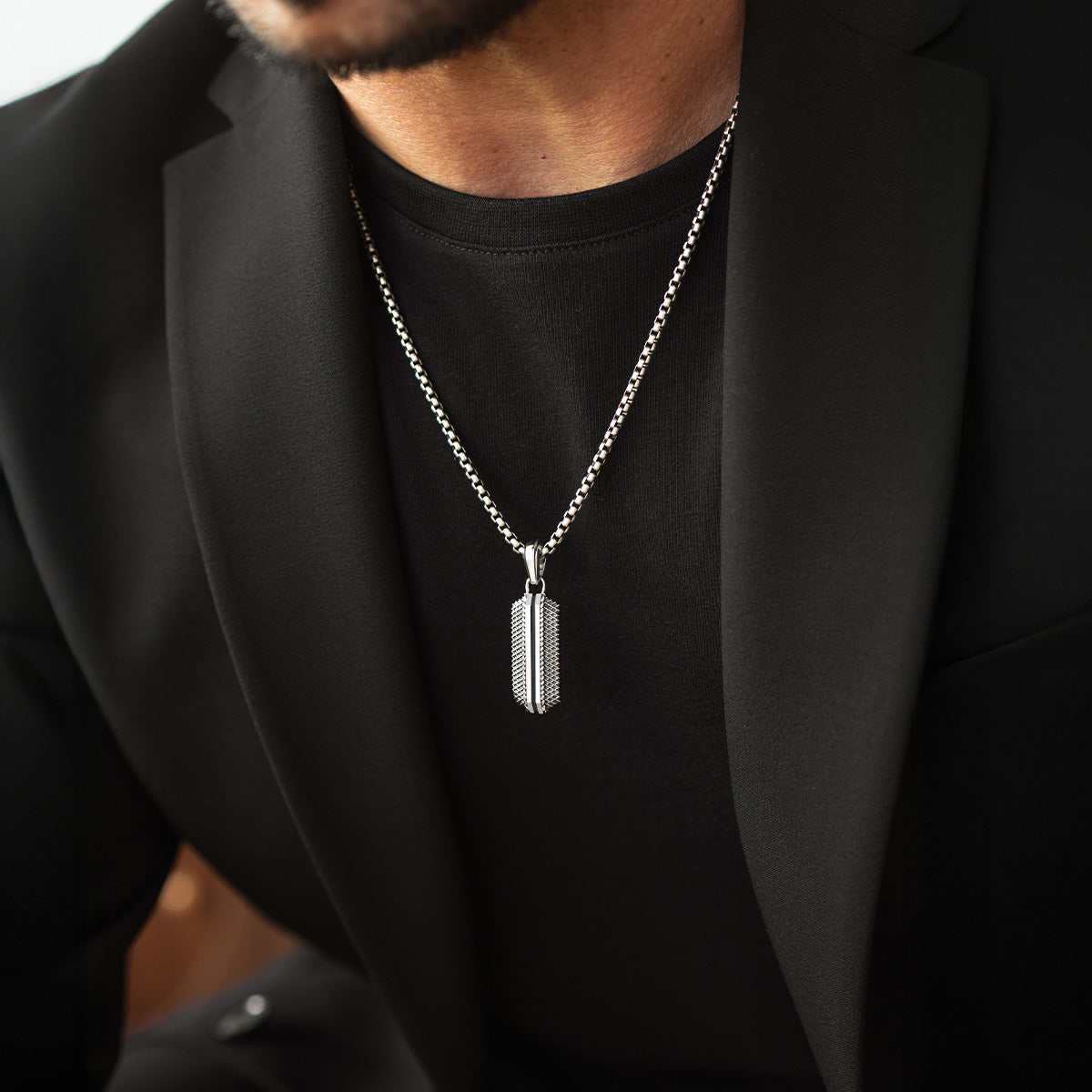
Leitfaden für Herrenketten

Silber Kette Herren

Leitfaden für Herrenketten

Die beste Kette für Anhänger: So wählen Sie das richtige Modell für Männer aus

von Adam NineTwoFive am 06. August 2026
Choosing the best chain for pendants is not just about finding the right metal or length. The chain type determines how your pendant hangs, whether it stays centred, how much it moves, and whether the bail will hold under daily wear. Get the combination right and the pendant becomes the focal point. Get it wrong and even a quality piece looks accidental. This guide covers every variable you need to decide. Why Chain Type Matters for Pendant Wear A chain is not simply a delivery mechanism for a pendant. Its structure, weight, and link design directly affect the pendant's behaviour throughout the day. A flexible cable chain allows a pendant to spin freely, often ending up face-backwards after a few hours. A rigid box chain keeps the pendant face-forward throughout normal movement. A thin chain under a heavy pendant will kink at the bail point and weaken over time. Choosing the best type of chain for pendants starts with understanding these physical relationships, not just the aesthetic ones. Best Chain for Pendants: Matched by Pendant Weight Pendant weight is the most important practical factor in chain selection and the one most often ignored. The chain must support the pendant's weight at a single point, the bail, while also handling the pendulum motion created by daily movement. The table below maps pendant weight to the best chain type, with NineTwoFive's specific chain options. The table shows that lighter pendants give you more flexibility in chain choice, while heavier pieces require structural priority over aesthetics. NineTwoFive pendants range from 6g for the stone-set Art Deco pieces to 8g for the plain Jamil, placing most of them in the 3mm box chain range as the best starting point. Best Type of Chain for Pendants: Each Style Explained The four main chain types for men divide broadly into two structural categories: rigid-link chains that hold the pendant stable, and flexible-link chains that allow movement. Both have their place, and understanding each one makes the choice straightforward rather than a matter of guesswork. Box Chain: Best All-Round Chain for Pendants The box chain is constructed from square links connected at right angles to each other. This rigid structure is what makes it the best chain for pendants in most situations. The square links do not flex the way round or oval links do, which prevents the pendant from rotating freely on the chain. The pendant stays centred and face-forward throughout normal daily movement rather than drifting sideways under a collar. NineTwoFive's Kamal is a 3mm Venetian box chain in solid 925 sterling silver. The Venetian construction is a refined variation on the standard box chain, with slightly elongated links that give the chain a cleaner surface profile while maintaining the same structural rigidity. At 3mm, it handles pendant weights from 5g to 12g without distortion and passes through NineTwoFive's 5mm pendant bail loops without resistance. The Kamal is available in 50cm, 55cm, and 60cm lengths. For help choosing the right length for your build and the pendant you have in mind, use our men's chain size chart. Rope Chain: Best for Heavier Pendants The rope chain is constructed from small links twisted together in a spiral pattern. This twisted structure distributes tensile load across multiple link contact points rather than concentrating it at a single join, which makes it the strongest chain type for pendant wear under weight. A rope chain carries pendant loads that would distort a cable chain and handles daily movement without stretching or flattening over time. NineTwoFive's Nadir is a 3mm twisted rope chain in solid 925 sterling silver, available in the same lengths as the Kamal. At 3mm it is strong enough for heavier pendant weights, including the Art Deco layered pieces like the Tahsin and Tahrir. The rope's twisted surface also adds visual texture that complements pendants with more complex designs or natural stone settings. Minimalist Chain: Best for Lightweight Pendants NineTwoFive's Emir is a 2.5mm minimalist chain with a slim, high-polished finish and a clean link profile. At this width, it is suited to lightweight pendants under 6g, where its subtlety allows the pendant to remain the sole visual focus. The Emir works particularly well with the Jamil plain pendant for men who want the pendant to read as floating rather than prominently framed. For pendants above 6g, upgrading to the Kamal box chain at 3mm provides the structural support the Emir's slim links cannot offer. Byzantine Chain: Best Worn Alone, Can Support Bold Pendants NineTwoFive's Ramsi is a 3.5mm Byzantine chain with a complex interlocked weave pattern inspired by classical chain architecture. The Byzantine weave has the visual presence to stand alone as a statement piece without any pendant, which is its primary purpose. For men who want to add a bold or substantial pendant to it, the Ramsi's 3.5mm width and interlocked structure can carry the weight, but the chain's own visual character will share attention with the pendant rather than deferring to it. It is best used without a pendant or with the most substantial statement pieces where the combination is deliberately bold. Shop now: Shop All Men's Silver Chains Matching Chain Design to Pendant Design Beyond structural suitability, the chain's design language should complement the pendant's character. Wearing an architectural geometric pendant on a heavily textured chain creates visual conflict; wearing it on a clean box chain creates coherence. The table below maps NineTwoFive's pendant range to the chain that best serves each design. The consistent principle across all combinations is that the chain's job is to support the pendant, not to compete with it. The only exception is the Ramsi Byzantine, which has sufficient design character to share the visual space with a bold pendant. In every other pairing, choosing the less visually complex chain produces the cleaner, more intentional result. For more on how current chain and pendant trends are developing in men's silver jewellery, read our guide on men's silver jewellery trends. Bail Diameter and Chain Width Compatibility The bail is the loop at the top of the pendant through which the chain passes. If the chain width is greater than the bail's internal diameter, the chain cannot pass through it. This is a practical constraint that applies before any aesthetic consideration and is the most common source of pendant and chain incompatibility when buying the two separately. NineTwoFive pendants have a 5mm internal bail loop. This accommodates chains up to approximately 4mm in width comfortably. The Emir at 2.5mm, the Kamal and Nadir at 3mm, and the Ramsi at 3.5mm all pass through the 5mm bail without resistance. A 5mm or wider curb chain would not, and attempting to thread it through would damage the bail loop. When buying a chain for an existing pendant, measure the bail's internal diameter first and confirm the chain width is at least 1mm narrower. Best Chain for Pendant by Occasion The right chain for your pendant also depends on where and how you are wearing it. The same pendant can read very differently depending on chain length and type, and calibrating that to the occasion produces a more considered overall look. The pattern across occasions is consistent: the more formal the setting, the shorter the chain, the slimmer the width, and the more the pendant should remain close to the collarbone rather than hanging prominently at mid-chest. The Kamal box chain at 50cm is the most versatile option across the widest range of contexts. For a full guide to layering chains and managing length across different outfits and occasions, read our men's chain layering guide. Shop now: Men's Silver Pendants Frequently Asked Questions What is the best chain for pendants? For most men's pendants, a 3mm box chain is the best all-round choice. Its rigid square links keep the pendant centred and face-forward throughout daily movement. NineTwoFive's Kamal Venetian Box Chain handles pendant weights from 5g to 12g and pairs with all bail sizes of 3mm or wider. What chain is best for a heavy pendant? A rope chain handles heavier pendants better than a box or cable chain. The twisted structure distributes load across multiple contact points rather than concentrating it at the bail join. NineTwoFive's Nadir at 3mm carries pendant weights up to 15g without stretching or distortion over time. Can I use any chain with any pendant? No. The chain must pass through the pendant's bail loop, so chain width cannot exceed the bail's internal diameter. NineTwoFive's 5mm pendant bail accommodates chains up to 4mm. Chain strength must also match pendant weight; a 2mm cable chain under a 12g pendant will kink at the bail over time. Why does my pendant keep spinning on the chain? Pendant spinning is caused by using a flexible chain such as a cable or thin rope chain, which allows the pendant to rotate freely. Switching to a rigid box chain prevents this. NineTwoFive's Kamal box chain holds pendants face-forward due to its square rigid links, which resist rotation throughout daily wear. Which NineTwoFive chain works best with pendants? The Kamal Venetian Box Chain at 3mm is the best starting point for most NineTwoFive pendants, including the Jamil, Tahsin, and Jalil. For heavier Art Deco stone-set pieces, the Nadir Twisted Rope Chain at 3mm provides additional tensile support. The Emir at 2.5mm suits lightweight bar or disc pendants only. Start with Weight, Finish with Design Choosing the best chain for pendants comes down to two decisions made in order: match the chain's structural strength to the pendant's weight, then match the chain's design language to the pendant's character. For most men's pendants, the Kamal box chain resolves both decisions cleanly. For heavier pieces, the Nadir rope chain provides the additional support. Start with those two and the rest follows. For guidance on keeping your chain in good condition over time, read our guide on how to clean a silver chain.
Wie Anhänger aus Sterlingsilber hergestellt werden: Vom Entwurf bis zum fertigen Schmuckstück

Leitfaden für Herrenketten

Wie Anhänger aus Sterlingsilber hergestellt werden: Vom Entwurf bis zum fertigen Schmuckstück

von Adam NineTwoFive am 05. August 2026
Most people who wear a sterling silver pendant never think about what went into making it. But the decisions made during the production process how the bail is constructed, how the stone is set, how the surface is finished are exactly what separates a pendant that lasts a decade from one that shows wear within a year. Understanding how to make sterling silver pendants at a professional level, and what each stage produces, changes what you look for when you buy. What Sterling Silver Pendants Are Made From The first thing to understand about how to make silver pendants professionally is the material itself, because it determines everything that follows. Sterling silver, marked with the 925 hallmark, contains 92.5% pure silver and 7.5% copper. Pure silver at 999 fineness is too soft for pendants worn daily it bends at the bail, scratches easily across the face, and loses its shape under normal contact. The copper addition provides the structural hardness needed without affecting the appearance or tarnish behaviour of the metal. For pendants specifically, the solid vs. plated distinction is more consequential than it is for rings. A plated pendant wears through most quickly at the bail, which is the point of highest friction against the chain. Every movement the wearer makes creates rotation or tension at the bail connection. Solid 925 sterling silver throughout means the bail is as durable as the pendant face the weakest point in a plated pendant becomes a non-issue in a solid one. The 925 stamp inside the bail loop or on the reverse of the pendant confirms this. For more on why solid 925 silver tarnishes naturally and what that confirms about the material, read our guide on does sterling silver tarnish. How Sterling Silver Pendants Are Designed Design is the stage that determines how the finished pendant will hang, how it will look in motion, and how long it will hold its character. Pendant design involves a set of considerations that ring design does not, and getting these right before any metal is cut saves significant rework at every subsequent stage. Pendant-Specific Design Considerations A ring is a circular form with consistent stress distribution around the band. A pendant is a flat or semi-three-dimensional form that must hang correctly from a single attachment point. The design must account for four things that ring design does not require: •  Centre of gravity: the pendant must hang without tilting to either side. An asymmetric form needs the bail positioned off-centre to compensate. •  Bail placement: the bail should sit in the top third of the pendant, not at the dead edge. This prevents the pendant from flipping face-backwards on the chain. •  Visual balance on both faces: unlike a ring, a pendant is seen from the front in daily wear but handled on both sides when put on, taken off, or gifted. Both faces must be considered. •  How the design reads at distance: pendants are seen from 30 to 60cm as the wearer moves. Fine detail that reads well in a photograph can disappear entirely in wear. From Sketch to CAD At NineTwoFive, every pendant begins as a hand-drawn sketch in the Netherlands studio, guided by the same architectural principles that shape every piece in the collection: clean geometry, precise proportion, balanced negative space. The sketch is converted into a CAD model that allows the design team to test the centre of gravity, check wall thicknesses, and simulate how the pendant will hang before any silver is involved. The CAD file also serves as the technical instruction set for the Balinese silversmiths who produce each piece. For more on the architectural design philosophy behind NineTwoFive's pendant range, read our source of inspiration. Two Ways to Make a Sterling Silver Pendant: Casting vs. Fabrication Understanding how to make sterling silver pendants requires understanding the two routes available to bring the design into physical form. The choice depends on the complexity of the design, the volume being produced, and the specific characteristics the finished pendant needs. Most quality production pendants combine both approaches: lost wax casting provides the precise form, and hand finishing delivers the surface quality that defines the finished piece. The casting stage is where the design is realised; the finishing stage is where the character of the piece emerges. NineTwoFive's Art Deco pendant range uses casting for the layered geometric form and hand finishing by Balinese artisans for the surface. Lost Wax Casting: How It Works for Pendants A wax model of the pendant is produced, either carved by hand or generated from a 3D-printed resin prototype derived from the CAD file. The wax is encased in an investment mould, fired in a kiln to burn out the wax completely, and molten 925 sterling silver is then poured or centrifugally cast into the resulting cavity. Once cooled, the pendant is removed from the mould at the sprue point and the real work of finishing begins. The pendant at this stage will show casting texture across its surface and will need significant progressive refinement before it is ready to wear. The same casting and hand-finishing approach applies across NineTwoFive's full range of solid silver pieces. For more on how this process shapes men's rings specifically, read our silver ring for men guide. The Bail: The Most Critical Element of a Sterling Silver Pendant The bail is the loop or fitting at the top of the pendant through which the chain passes. It is the smallest component of the piece and, structurally, the most important. Every time the wearer moves, the bail rotates against the chain, bears friction, and absorbs tension. A pendant worn every day for a year makes this contact hundreds of thousands of times. The quality of the bail determines whether the pendant is still intact at the end of that period. Types of Bail and What They Mean for Durability There are three main bail constructions, and each produces a different outcome for long-term wear: •  Solid tube bail (drilled and soldered): the strongest construction. A section of solid silver tube is soldered to the top of the pendant. The tube wall is thick enough to resist thinning under daily friction. The solder join, when executed correctly, is as strong as the surrounding metal. •  Loop bail (wire bent into loop): adequate for occasional wear but thins faster under daily friction. The wire cross-section is small to begin with, and abrasion from the chain reduces it further over time. The bend point is also a stress concentration. •  Integrated bail (cast as part of pendant body): the most structurally sound option because there is no separate join point. The bail and pendant are one continuous piece of metal. NineTwoFive pendants use a bail with a 5mm loop diameter, compatible with all box chain sizes in the collection. The practical check when buying: press the bail gently between finger and thumb. A solid tube bail will not deform. A thin wire loop will flex noticeably. This single test tells you more about the pendant's longevity than any finish quality assessment. NineTwoFive pendants use a 5mm bail loop, compatible with the full range of chain sizes in the collection. To find your ideal chain length and width, use our men's chain size chart. Setting Stones in Silver Pendants Stone setting in pendants is technically different from ring setting because gravity acts differently on a pendant face. A ring stone is set horizontally and held in place by the setting under constant downward pressure. A pendant stone is set vertically in daily wear the stone faces forward and must be held securely against both lateral movement and the occasional forward knock. This means pendant stone settings are typically tighter than equivalent ring settings. Bezel Setting for Pendants Bezel setting surrounds the stone with a continuous rim of silver that is pressed over the edge of the stone to hold it in place. It is the most secure setting for a pendant worn daily because the stone is fully enclosed on all sides, making it resistant to both lateral movement and forward impact. The height of the bezel must be calibrated precisely: too high and the bezel wall covers the character of the stone; too low and the rim cannot generate enough grip to hold securely under movement. NineTwoFive's stone-set pendants use bezel settings in which the silver frame becomes part of the design geometry rather than a functional afterthought. In the Tahsin (Black Onyx) and Tahrir (Blue Pietersite), the bezel sits within an Art Deco layered structure that frames the stone as the visual focal point of the pendant face. The setting and the design are resolved together, not separately. For more on how stone-set pendants and chains fit into current men's silver jewellery, read our guide on men's silver jewellery trends. Shop now: Men's Silver Pendants Filing, Finishing, and the Two-Sided Challenge Finishing is the stage that takes the pendant from a functionally complete casting to a piece ready to wear. It is also where most of the time is spent, and where the visible quality of the piece is established. The process moves through progressively finer abrasives, removing the marks from each previous stage until the surface is ready for its final treatment. The abrasive sequence for a pendant face typically runs: •  Coarse files to remove casting sprue and major surface irregularities •  220 grit sandpaper to remove file marks •  400 and 600 grit to refine the surface further •  800 to 1200 grit to prepare for polishing compound •  Polishing compound on a soft cloth or buffing wheel for the final surface The pendant-specific challenge at this stage is that both faces require the same level of attention. The front face is the one seen in daily wear. The back face is the one handled when the pendant is put on, taken off, examined by a potential buyer, or engraved. A piece where the back is left rough or uneven while the front is polished to a mirror finish reveals that the silversmith treated the pendant as a display object rather than a wearable one. Engraving as the Final Finishing Stage Engraving on a pendant is applied after all other finishing is complete. Laser engraving, which NineTwoFive uses across all pendant types, is applied to the fully polished back face. The laser removes material precisely without heat distortion, which means the surrounding surface is not affected by the engraving process. The engraved text or symbol sits cleanly against the polished silver because the surface was brought to its final quality before the laser touched it. For guidance on maintaining your pendant and chain in daily wear, including how to clean silver safely at home, read our guide on how to clean a silver chain. What the Making Process Means for the Pendant You Wear Understanding how sterling silver pendants are made changes what to look for when choosing one. Every quality indicator that matters to a buyer corresponds directly to a stage in the making process. The table below maps the checklist to the craftsmanship behind it. Each point on the checklist reflects a specific stage in making the pendant: the hallmark confirms material at the source; the bail quality reflects the construction stage; the surface consistency reflects the filing and finishing work; and the stone security reflects the precision of the bezel calibration. A pendant that passes all six checks has been made with care at every stage, not just the stage visible from the front. For guidance on choosing the right chain length and style to pair with your pendant, read our men's chain layering guide. Frequently Asked Questions How are sterling silver pendants made? Quality silver pendants are made through five stages: designing with pendant-specific constraints, casting or fabricating the form, constructing the bail, setting any stones, and finishing through progressive filing and polishing on both faces. Solid 925 sterling silver is used throughout. What is a bail on a pendant and why does it matter? The bail is the loop at the top of the pendant through which the chain passes. It bears more friction than any other part of the piece. A solid tube bail lasts significantly longer under daily wear than a thin wire loop, which thins and weakens over time. How are stones set in silver pendants? Bezel setting is the most common method for daily-wear pendants. A continuous silver rim is pressed over the stone edge to hold it securely against lateral movement and forward impact. The bezel height must be calibrated precisely so the stone is secure without being obscured. What does the 925 stamp mean on a pendant? The 925 hallmark confirms solid sterling silver throughout: 92.5% pure silver and 7.5% copper. It should appear on the pendant reverse or inside the bail loop. A pendant without this mark is either plated or made from a base metal alloy. How can I tell if a silver pendant is well made before buying? Press the bail to confirm it is solid, not a thin wire loop. Examine the surface under direct light for consistent finish with no pitting. Check that any stone does not move when pressed. Confirm the reverse face is finished to the same standard as the front. Craft Is What You Wear Every Day Sterling silver pendants that last are made with care at every stage: from the design that places the bail correctly to the finishing that treats both faces as equally important. Knowing how to make silver pendants at a professional level does not make buying one more complicated. It makes it clearer. The hallmark, the bail, the surface finish: these are visible evidence of everything that happened in the workshop before the pendant reached you. Shop now: Pendant and Ring Sets
Silberanhänger für Herren

Leitfaden für Herrenketten

Arten von Halskettenanhängern für Männer: Ein umfassender Leitfaden zu allen Stilen

von Adam NineTwoFive am 04. August 2026
The main types of necklace pendants for men are geometric and architectural pendants, stone-set pendants, symbolic pendants such as anchors and crosses, dog tag and bar pendants, engraved and personalised pendants, religious pendants, and locket pendants. Each type carries a different visual weight and meaning, making the right choice dependent on personal style, wearing context, and intended purpose. This guide covers the key necklace pendant types for men, including what distinguishes each one and when it works best. Types of Necklace Pendants: An Overview Before looking at each type individually, it helps to understand what distinguishes one pendant type from another. The categories below are defined primarily by design language and by the role the pendant plays, rather than by size or material alone. Two pendants can be made from the same solid 925 sterling silver at identical dimensions and still communicate entirely different things about the person wearing them. The overview makes clear that types of necklace pendants differ more fundamentally in purpose and character than in physical specification. Understanding these differences is what turns pendant choice from a matter of aesthetics into a matter of intention. Geometric and Architectural Pendants Geometric and architectural pendants are defined by form rather than symbol. There is no motif to interpret and no cultural reference to decode. The pendant communicates through the precision and clarity of its structure, which makes it the types of pendants for necklaces that suits men who prefer their jewellery to speak through design quality rather than through recognisable iconography. The category runs from simple flat geometric shapes - bars, rectangles, discs, hexagons - through to more complex layered structures inspired by architectural design. NineTwoFive's Jamil is a plain geometric pendant in mirror-finish sterling silver, defined entirely by its proportions and surface. The Tahsin and Tahrir take that geometric foundation into Art Deco territory, combining layered structural forms with a natural stone to add depth without introducing decoration in the conventional sense. Who This Type Suits The man who chooses a geometric pendant values intention and restraint. He is not using a symbol to communicate a value; he is communicating through the quality and character of the object itself. This pendant type works consistently across daily wear, office settings, and smart casual occasions because its presence is considered without being demanding. Pairing Geometric Pendants with a Chain The design logic of a geometric pendant should carry through to the chain. A box chain shares the same structural, geometric character as the pendant and pairs naturally without visual conflict. A chain length of 50 to 55cm positions the pendant at the collarbone where it reads clearly without disappearing under a collar in everyday wear. Stone-Set Pendants Stone-set pendants add a layer of natural character that solid metal alone cannot replicate. The stone brings organic texture, depth of colour, and visual contrast to the pendant structure. Because each stone is individually formed, no two stone-set pieces are precisely alike, making this one of the most distinctive types of necklace pendants for men who want something that looks considered and personal without requiring an engraving. The choice of stone shapes the entire character of the pendant. Black Onyx produces a pendant that reads as controlled and grounded: deep black against polished silver, high contrast, direct. Blue Pietersite produces something rarer, a stone whose colour shifts visibly with the light, making each piece genuinely unrepeatable. Both appear in the NineTwoFive range within Art Deco geometric settings that frame the stone as the visual focal point. Choosing the Right Stone for Daily Wear Hardness matters when choosing a stone for a pendant worn every day. Harder stones such as onyx, sapphire, and pietersite hold up well under daily contact and minor abrasion. Softer or more porous stones such as turquoise or opal are better reserved for occasional wear. For a pendant intended to be worn consistently, a hard stone in a secure bezel or rubover setting provides the best balance of durability and visual presence. For more on how stone-set silver jewellery fits into current men's styling, read our guide to men's silver jewellery trends. Shop now: Men's Silver Pendants Symbolic Pendants Symbolic pendants use recognisable visual language to carry meaning without words. The anchor, the compass, the arrow, the north star - each of these motifs has accumulated associations over time that most people will read without needing them explained. This makes symbolic pendants a communicative type of necklace pendant: wearing one signals something specific about the wearer's values, priorities, or identity in a way that a plain geometric pendant does not. Common Symbols and What They Mean for Men The anchor represents stability, groundedness, and the ability to hold steady under pressure. The compass represents direction and purpose, often chosen by men navigating significant changes or transitions. The arrow points forward, carrying associations of focus and intention. The skull, frequently misread as a dark symbol, carries meaning around living fully and acknowledging the value of the present rather than deferring it. The practical consideration when choosing a symbolic pendant: wear a symbol because it carries genuine personal resonance, not because it appears popular or fills a gap in a look. A symbol with real meaning behind it reads differently to one selected without thought, and the difference is visible to most people who pay attention to jewellery. Dog Tag and Bar Pendants Dog tag and bar pendants are the most understated who want a piece that carries personal information without making a visual statement. The dog tag is a flat rectangular metal plate, plain by design, originally associated with military identification and now entirely repurposed as a personal accessory. The bar pendant is a slim horizontal or vertical metal bar - clean, architectural, and well-suited to engraving along its face or reverse. Both types work well as a starting pendant for men new to wearing jewellery, because their minimal profile is easy to wear confidently across multiple contexts. When engraved with a name, date, or short phrase, either type becomes a personal document rather than a generic accessory. NineTwoFive offers free laser engraving across all pendant types, which makes the bar format a natural choice for men who want maximum personalisation with minimum visual complexity. For guidance on which chain lengths and styles work best with bar and minimal pendants, read our men's chain layering guide. Engraved and Personalised Pendants Engraved pendants are not a pendant type in the same way that geometric or symbolic pendants are - they are a dimension that can be applied to any of the types in this guide. What makes engraving worth addressing separately is that it changes the fundamental nature of the piece. A plain pendant communicates through its design. An engraved pendant communicates through its design and through a specific, unrepeatable piece of personal information that only the wearer and the giver fully understand. A date, a name, a coordinate, or a short phrase engraved on the back of a geometric pendant creates a private layer of meaning invisible to anyone but the wearer. This is why engraved pendants work so consistently as gifts - the giver cannot produce one without thought, and the recipient cannot wear one without the thought being present. NineTwoFive offers free laser engraving on every pendant in the collection, applied to the reverse to keep the front design clean. Religious Pendants Religious pendants are among the most personal of all the types of necklace pendants. A cross, a Star of David, a Hamsa, a Crescent - each carries cultural and spiritual weight that extends far beyond aesthetics. The design is universally recognised, which means wearing one communicates identity clearly and immediately in a way that most other pendant types do not.  The most important consideration when choosing a religious pendant is authenticity: these pieces work best when the wearer has a genuine connection to what the symbol represents. Sterling silver suits everyday religious pendants well, handling daily wear without the maintenance demands of gold and complementing both plain and intricate pendant designs equally. How to Choose the Right Type of Pendant for You With the full range of types of pendants for necklaces understood, the practical question is which one fits your specific situation. The table below maps personal priorities directly to pendant types, providing a framework that goes beyond visual preference and addresses the underlying purpose of the piece. The most common mistake across all necklace pendant types is choosing based on how a piece looks in a photograph rather than what it will mean in daily wear. A pendant that is visually striking but has no personal relevance is unlikely to become a piece worn consistently. The pendant types that last longest in a collection are those chosen with a clear sense of why. To find the right chain length to pair with your chosen pendant type, use our men's chain size chart. Frequently Asked Questions What are the different types of necklace pendants? The main types of necklace pendants are geometric and architectural pendants, stone-set pendants, symbolic pendants such as anchors and compasses, dog tag and bar pendants, engraved and personalised pendants, religious pendants, locket pendants, and animal or motif pendants. Each type is distinguished by its design language, the kind of meaning it carries, and the contexts in which it works best. What types of pendants for necklaces suit men best? The types of pendants for necklaces that suit most men are geometric and architectural pendants for their clean, minimal presence; stone-set pendants for natural depth and visual interest; and engraved bar or dog tag pendants for personalised everyday wear. The best choice depends on personal character, lifestyle, and whether the pendant is primarily for aesthetic or personal meaning purposes. What is the most popular type of pendant for men? Geometric and symbolic pendants are among the most worn types for men. Geometric pendants suit men who prefer understated design, while symbolic pendants such as the cross and anchor remain consistently popular for their personal and cultural associations. Stone-set pendants have grown significantly as a men's pendant type as natural materials become more mainstream in men's jewellery. What type of pendant is best for everyday wear? Geometric and architectural pendants in solid sterling silver are among the best types of necklace pendants for daily wear because their design does not rely on fragile surface details and their solid construction handles regular contact well. Stone-set pendants with harder stones such as onyx or pietersite also suit daily wear when the stone is set in a secure bezel or rubover setting. What type of pendant makes the best gift for a man? An engraved geometric or bar pendant is consistently the most considered gift option because the engraving cannot be added without a deliberate choice of what to inscribe. A date, a name, or a short phrase converts any pendant type into something personal and specific to the recipient. Stone-set pendants make strong second choices for men who respond to natural materials and distinctive design. What chain suits each type of pendant? Geometric and architectural pendants pair best with a box chain, which shares the same structural clarity. Stone-set pendants also work well on box or rope chains, which provide enough weight and grip to keep the pendant centred. Symbolic and religious pendants work on most chain types. Dog tag pendants traditionally pair with a curb or box chain to maintain their clean, direct aesthetic. What is the difference between a geometric and a symbolic pendant? A geometric pendant communicates through its form alone: the shape, proportions, and surface quality carry the message without reference to any external meaning system. A symbolic pendant communicates through an established cultural or personal motif such as an anchor or cross. Geometric pendants are therefore more neutral in terms of what they say about the wearer, while symbolic pendants are more specific. Can any type of pendant be engraved? Most solid sterling silver pendant types can be engraved, including geometric, bar, dog tag, and locket pendants. The engraving is most commonly applied to the reverse of the pendant, keeping the front design intact. Stone-set pendants can usually be engraved on the reverse of the silver frame. NineTwoFive offers free laser engraving on every pendant in the collection. Choose by Purpose, Not by Trend The types of necklace pendants available for men cover a wide range: from architectural geometric pieces built entirely on form to stone-set pendants that add natural depth, and from symbolic pieces that carry public meaning to engraved pendants that carry private meaning. Each type serves a different purpose. The right choice is not the most popular type, but the one that fits what you want the pendant to do for you. For guidance on keeping your pendant and chain in good condition over time, read our guide on how to clean a silver chain. Shop now: Men's Silver Chains
Anhänger an einer Kette

Leitfaden für Herrenketten

So trägt man zwei Anhänger an einer Kette: Ein Leitfaden für Männer

von Adam NineTwoFive am 03. August 2026
Knowing how to wear multiple pendants on one chain is one of the most practical skills in men's jewellery. Wearing 2 pendants on one chain is a clean way to add personal meaning or visual interest without doubling your chain count. Most men who try it get it slightly wrong, not because the approach is complicated, but because a few specific decisions about chain type, pendant pairing, and spacing make the difference between a look that reads intentional and one that reads cluttered. This guide covers every one of those decisions. 2 Pendants on One Chain vs. Two Separate Chains Can you wear two pendants on one chain? Yes, but before covering how to do it well, it helps to understand what the approach involves and how it differs from wearing two separate necklaces. The two are not the same thing, and each has different requirements and different results in daily wear. For men who want a cleaner, more controlled look, 2 pendants on one chain is almost always the better starting point. One clasp, one visual line, and a setup that requires no adjustment throughout the day. Two separate chains gives more flexibility but introduces a second clasp and makes it harder to control how the pieces interact during movement. How to Wear Two Pendants on One Chain: Three Methods There are three ways to physically attach two pendants to one chain. The method you choose shapes how the pendants sit, move, and interact throughout the day. Understanding which method suits your situation before starting is the foundation of knowing how to wear multiple pendants on one chain correctly. The stagger method is the most practical for daily wear. It keeps both pendants visible, prevents them from overlapping during movement, and requires no additional tools or jump rings. The cluster method works well when both pendants are part of a deliberate pairing and share design elements, reading as a single combined piece rather than two separate focal points. Method 1 (Stagger): Step by Step To stagger two pendants on one chain, slide the first pendant onto the chain using its bail or jump ring and position it roughly at the midpoint. The second pendant goes closer to the end clasp, leaving 5 to 10cm of chain between them. Position the lighter or smaller pendant higher on the chain and the heavier or more prominent one lower. When the chain is worn, gravity naturally keeps the lighter piece from sliding down into the heavier one, maintaining the spacing without any additional fixings or glue. What Makes the Stagger Method Work for Men The stagger method suits men's daily wear particularly well because it requires no maintenance during the day. The pendants stay separated by their own weight differential, they do not tangle under normal movement, and the visual line they create is clean and vertical rather than clustered at one point. The cluster method, by contrast, works better as a deliberate style choice for social occasions than as an everyday solution for men who want a low-maintenance look. Choosing the Right Chain for Two Pendants Chain selection matters more when wearing two pendants than when wearing one. A chain that handles a single pendant comfortably may distort, twist, or weaken under the combined weight of two pieces. The type of chain also directly affects how likely the pendants are to tangle during daily wear. Box chain and rope chain are the two most practical options for wearing 2 pendants on one chain. Their structural properties keep pendants from spinning freely or travelling along the chain during movement. Thin cable chains below 2mm are best avoided entirely when adding a second pendant, as the links flex too much to hold both pieces in a stable position throughout the day. For a full breakdown of chain types, weights, and how to choose the right length for your build, read our men's chain layering guide. How to Pair Two Pendants That Work Together Not every combination of pendants works well on the same chain. The most common pairing mistake is choosing two pieces that are too similar in size, weight, and visual prominence. When both pendants compete equally for attention, neither one stands out clearly, and the overall look reads as cluttered rather than layered. Size and Weight: The Anchor and Accent Rule The single most effective rule when wearing two pendants on one chain is to use one anchor pendant and one accent pendant. The anchor is the more prominent piece: larger, heavier, or more visually complex. The accent is the supporting piece: smaller, lighter, or simpler in design. This pairing gives the eye a clear focal point and a secondary detail rather than two competing centres that cancel each other out. As a practical example from the NineTwoFive range: the Jamil (solid plain silver, 8g, architectural minimal) works well as the accent alongside the Tahsin (Art Deco stone-set, 6g, layered geometric) as the anchor. The Jamil's clean surface lets the Tahsin's stone and structure read clearly as the dominant piece without either fighting for space. Matching Design Language Across Both Pendants Beyond size and weight, both pendants need to share a design language to read as intentional rather than accidental. Two architectural geometric pendants in the same finish will always read as a deliberate pairing. A minimal silver bar alongside an ornate engraved circular disc in different finishes reads as two items that happened to end up on the same chain. The practical rule: match the surface finish across both pendants - both polished, both matte, or both brushed - and keep the design vocabulary consistent. Mixing minimal with ornate, or flat with three-dimensional, produces results that look unplanned rather than chosen, regardless of how individually good each pendant is. Shop now: Men's Silver Pendants How to Prevent Tangling When Wearing Two Pendants on One Chain Tangling is the most common practical problem when wearing multiple pendants on one chain, and it almost always comes from the same set of causes. Understanding what drives it makes prevention straightforward. Tangling happens when the pendants are too close together on the chain, when they are the same weight and spin freely into each other, or when the chain is too thin and flexible to hold both pieces in a stable position. The most effective fix is spacing: keep at least 5cm between the two pendants on the chain, position the heavier piece lower so gravity provides natural separation, and use a chain with rigid or semi-rigid links such as a box chain or rope chain. When storing the necklace, keep the chain flat rather than coiled tightly at the clasp, which is where most tangles begin. If the pendants tangle during wear, hold the lower pendant still, give the chain a light upward shake from the top, and the pieces will return to their natural separated positions without needing to be removed and reset. For more on keeping your chain in good condition over time, including how to clean it safely at home, read our guide on how to clean a silver chain. When to Wear Two Pendants on One Chain: Occasion Guide Two pendants on one chain works across several contexts for men, but it does not suit all of them equally. The occasion guide matters here because the environments men typically dress for have specific expectations around visual restraint, and the number of visible pendants contributes to that reading whether you intend it to or not. The consistent pattern: casual and smart casual contexts give the most room for wearing 2 pendants on one chain; office contexts work when the design is understated; formal settings are better served by one pendant or none at all. The size and finish of the pendants matter as much as the count - two slim architectural pendants in polished silver read very differently in a business context than two bold statement pieces. Common Mistakes When Wearing 2 Pendants on One Chain Most mistakes when wearing 2 pendants on one chain come from applying general layering logic to a single-chain setup without adjusting for the specific constraints involved. The three most common errors are also the most preventable. Two Pendants of Equal Size and Weight When both pendants are the same size and visual weight, neither one reads as the focal point. The look becomes a visual draw rather than a composition, which is the opposite of what layering is intended to achieve. The fix is to designate one as the anchor and choose the second specifically to support it, not to match or compete with it. Chain Too Thin for the Combined Weight A 1.5mm cable chain under two 8g pendants will kink at the clasp point, distort the visual line, and weaken at the links over time under the additional weight. Two pendants means double the load at the same attachment point. The fix is to use a chain of at least 3mm in a structured link style, such as a box chain or rope chain, that distributes the pendant weight more evenly along its length. Mismatched Finish Across Both Pendants A high-polish pendant alongside a matte-finish piece in the same look reads as two items that were not chosen together. Finish mismatch is more visually disruptive than a size difference because it signals that the combination was not intentional. The fix is to confirm the surface finish of both pendants matches before combining them on one chain, which is the single fastest way to make any two-pendant combination look considered. For more on current men's silver jewellery styling, including how chain layering fits into broader trends, read our guide on men's silver jewellery trends. Frequently Asked Questions Can you wear two pendants on one chain? Can you wear two pendants on one chain? Yes. It works well when the pendants are staggered at different heights with 5 to 10cm of space between them, the chain is a structured style such as a box or rope chain, and one pendant acts as the focal point while the other supports it. The approach requires one clasp and creates a cleaner look than two separate chains for most men. How do you wear multiple pendants on one chain without tangling? Use the stagger method: position the lighter pendant higher on the chain and the heavier pendant lower, leaving at least 5cm of chain between them. The weight difference naturally keeps the pieces separated during movement. Use a box chain or rope chain rather than a thin cable chain, as structured links prevent the pendants from spinning and wrapping around each other. How far apart should two pendants be on a chain? Five to ten centimetres is the practical range for most men's pendant combinations. Less than 5cm and the pendants will overlap during movement; more than 10cm and the pairing begins to read as two separate pieces rather than a considered combination. The exact spacing depends on the size and weight of each pendant: larger pendants need more space than smaller ones. Can I put two pendants on a box chain? Yes. A box chain is one of the best chain types for wearing two pendants because its rigid link structure holds both pieces in position without allowing them to spin or travel along the chain. A box chain of 3 to 4mm width provides enough structural support for most pendant combinations without looking too heavy for everyday wear. What is the best method for wearing 2 pendants on one chain? The stagger method is the best approach for most men's daily wear. Slide one pendant onto the chain at the midpoint and the second closer to the clasp end, leaving 5 to 10cm between them. Position the smaller or lighter piece higher and the larger or heavier piece lower. This requires no additional tools, maintains itself throughout the day, and produces a clean vertical line. How many pendants can you wear on one chain? Two is the practical limit for most daily wear situations. Three pendants on one chain is possible with the stagger method but requires a heavier chain and careful attention to spacing to avoid a cluttered look. Beyond three, the visual weight becomes difficult to balance and the combination generally reads as too busy for most men's everyday contexts. Do two pendants on one chain look good on men? Yes, when the combination follows the anchor-and-accent rule, uses a structured chain, and matches the finish across both pieces. The look works particularly well in casual and smart casual settings. It reads as deliberate and personal rather than heavy or overdone when the pairing has been chosen with a clear visual logic behind it. Which chain is best for wearing two pendants? A box chain of 3 to 4mm width is the most practical option for wearing two pendants. Its rigid links hold both pieces in a stable position throughout the day and prevent tangling. A rope chain in a similar width is also a good choice. Avoid thin cable chains below 2mm, which lack the structural integrity to support two pendants comfortably over time. Two Pendants, One Chain, One Clear Rule Wearing 2 pendants on one chain is a practical and considered approach for men who want more from a single piece of jewellery. The stagger method, a structured chain, and the anchor-plus-accent rule resolve the problems that make layering look unintentional. Start with two pieces that share a finish and a design language, and the result reads as deliberately chosen rather than assembled by chance. To find the right chain length before adding a second pendant, use our men's chain size chart. Shop now: Men's Silver Chains
Anhänger

Leitfaden für Herrenketten

Was bedeutet ein Anhänger? Definition, Symbolik und warum Männer sie tragen

von Adam NineTwoFive am 01. August 2026
The pendants meaning covers two layers. At its most basic it is a definition: a hanging piece of jewellery attached to a chain. But what a man chooses to wear around his neck, and why, says something specific about his character and values. This guide answers what does pendants mean across both layers: the pendants definition and the deeper symbolism, from design to material to engraving. Pendants Definition: What a Pendant Actually Is To define pendants correctly, they must be separated from the necklace. A pendant is the decorative element only: the piece with the design, the stone, or the inscription. The chain is what goes around the neck. Together they form a pendant necklace, but they are distinct parts with distinct roles. NineTwoFive pendants come with a matching box chain included, so define pendants as a system: the design, the material, and the chain are considered together from the start. The pendant and its chain are designed as a system, not as separate decisions, which ensures the weight and proportions work together from the start. What the Meaning of Pendants Goes Beyond Decoration A pendant hangs closer to the chest than any other piece of jewellery. It is not always visible to others, particularly when worn under a shirt. This is what makes the pendant meaning distinct: it is often chosen for personal significance rather than display. A daily reminder, a marker of identity, a physical record of a moment. A ring or bracelet is always visible; a pendant can remain private in a way that other pieces cannot. Understanding the pendants meaning in practice means recognising two broad categories. A statement pendant is designed to communicate visually. A personal pendant is worn for what it means to the individual, regardless of whether anyone else notices. Understanding which type you are looking for changes everything about which pendant to choose. What Different Pendant Designs Mean for Men The design a man chooses communicates something specific. Each form carries associations built over time. The table below maps the most common pendant design types to what they mean, including where NineTwoFive's pieces sit within that picture. Design and meaning are linked but not locked. The same shape carries different associations depending on material and scale. What matters is choosing with awareness of what the design says, so the pendant works for its intended purpose. What Architectural Pendant Design Says NineTwoFive's pendants are built around form, not symbols. The Jamil is a clean geometric piece in mirror-finish sterling silver, defined entirely by proportion and surface. The Tahsin and Tahrir layer Art Deco structure across a geometric base, adding depth without adding decoration. No anchors, no crosses, no motifs. Wearing a geometric architectural pendant communicates intention through restraint: a confidence that does not need explanation. What the Material of a Pendant Means Material carries its own layer of meaning before the design is considered. Two pendants sharing the same shape communicate differently depending on what they are made from. The combination most specific to men who want both structure and character is silver paired with natural stone. The silver provides precision; the stone provides texture and depth. The Tahsin with Black Onyx and the Tahrir with Blue Pietersite sit in exactly this space within the NineTwoFive collection. Why Men Wear Pendants The reasons men wear pendants have not changed as much as the designs have. Understanding the motivation clarifies what kind of pendant to look for. As a Daily Reminder A pendant worn close to the chest and often hidden under clothing is frequently a private act. A date, a coordinate, a design connected to something meaningful. Not worn for display, but worn to know it is there. The pendant becomes part of a daily routine without being a performance. As a Marker of Personal Character A pendant chosen for its design language reflects the character of the person who chose it. Over time, a piece worn consistently becomes associated with its wearer the way a watch or a style of dress does. The design, material, and scale all send signals that accumulate into something recognisable. As a Gift That Carries Shared Meaning When given as a gift, the meaning of pendants doubles. The giver has chosen something that represents how they see the recipient. When engraved with a date, a name, or a phrase, a third layer is added: a permanent record of the relationship between giver and receiver. An engraved pendant cannot be given without thought, and cannot be worn without the thought being present. For more on choosing jewellery gifts that will genuinely be worn, read our guide on gift ideas for men. What an Engraved Pendant Means Engraving converts a design choice into a personal document. A date records a moment. A name records a person. A coordinate records a place. A short phrase records a belief. None of these transfer to another person without losing their meaning - the engraving is part of the pendant's identity, not just its decoration. This is why engraved pieces are often worn longer and more consistently: the attachment is stronger because the object is more specifically itself. NineTwoFive offers free laser engraving on every pendant, applied to the back of the piece so the front design stays clean while the personal meaning sits privately against the chest. Shop now: Men's Silver Pendants Pendant and Chain: How the Combination Shapes the Meaning The chain a pendant hangs from is part of the overall statement. Weight comes first: a pendant significantly heavier than its chain pulls the necklace down and disrupts the visual line. NineTwoFive pendants come paired with a box chain matched to each design's weight and proportions. Length shapes where the pendant sits and how visible it is. At 50cm it sits closer to the collarbone and reads as more prominent. At 60cm it drops lower and layers more easily with other chains. For guidance on chain lengths and how to layer multiple pieces, read our men's chain layering guide. How to Choose a Pendant That Has Meaning for You The most common mistake when choosing a pendant is selecting for design alone without considering purpose. The most enduring pieces are chosen with a clear sense of what they mean to the person wearing them. The table below maps intention directly to the right piece. A pendant chosen with clarity about its purpose becomes a daily-wear piece. One chosen only for how it looks in a photograph rarely does. To find the right chain length to pair with your pendant, use our men's chain size chart. Frequently Asked Questions What does pendants mean? When people ask what does pendants mean, they are usually asking one of two things: what a pendant is as an object, or what wearing one represents. A pendant is a decorative piece that hangs from a chain. What it means symbolically depends on its design, material, and whether it carries a personal engraving. What does pendant mean in jewellery? A pendant is the decorative piece that hangs from a chain, cord, or necklace. The word comes from the Latin pendere, meaning to hang down. It refers to the object itself, not the chain it hangs from. A pendant and a chain together form a pendant necklace. What is the difference between a pendant and a necklace? A necklace is the complete piece worn around the neck, including the chain. A pendant is the hanging decorative element only. Pendants can be removed and swapped onto different chains; a necklace without a pendant is simply a chain worn alone. What does wearing a pendant say about you? The design and material of a pendant reflect the wearer's character. An architectural geometric pendant projects intention and restraint. A stone-set pendant adds depth and a tactile quality. An engraved pendant signals a personal connection to a specific moment, person, or place. Each choice communicates something specific about who is wearing it. What does a silver pendant mean? The pendant meaning in silver is understated confidence: quality without display, material integrity without the statement of gold. Solid 925 sterling silver has a cooler, more modern tone that suits men who prefer their jewellery to be deliberate rather than conspicuous. What does an engraved pendant mean as a gift? An engraved pendant as a gift carries meaning on two levels: the design chosen for the recipient reflects how the giver sees them, and the engraving records something permanent between them. A date, a name, or a phrase turns the pendant into a personal document that belongs to that person and that relationship specifically. Where does the word pendant come from? The word pendant comes from the Latin pendere and the Old French pendre, both meaning to hang down. This etymology captures precisely what a pendant is: a piece held by a loop or bail, hanging freely from a chain. The same Latin root gives English the words pending, pendulum, and suspend. A Pendant Is Defined by the Person Wearing It The pendants definition is straightforward: a hanging decorative piece attached to a chain. But the pendants meaning is defined by the person wearing it. Design, material, stone, engraving, and chain all contribute to what the piece communicates. Choose with those layers in mind, and a pendant becomes more than jewellery. It becomes something permanently and specifically yours. For guidance on keeping your pendant and chain looking their best over time, read our guide on how to clean a silver chain. Shop now: Pendant and Ring Sets
Ein Mann in einem schwarzen T-Shirt ohne Kragen, der drei verschiedene silberne Ketten trägt, um unterschiedliche Längen zu zeigen

Leitfaden für Herrenketten

Der ultimative Leitfaden zum Kombinieren und zur Länge von Herrenketten (Großbritannien)

von Sachini Uduge am 11. November 2025
Silberkette für Herren: Wie reinigt man eine Silberkette zu Hause?

Leitfaden für Herrenketten

Silberkette für Herren: Wie reinigt man eine Silberkette zu Hause?

von Sachini Uduge am 17. September 2025
Model trägt eine silberne Herrenkette mit einem Herrenanhänger

Leitfaden für Herrenketten

Silberkette für Herren: Wählen Sie das passende Modell und die richtige Größe

von Sachini Uduge am 15. September 2025