Knowing how to wear multiple pendants on one chain is one of the most practical skills in men's jewellery. Wearing 2 pendants on one chain is a clean way to add personal meaning or visual interest without doubling your chain count. Most men who try it get it slightly wrong, not because the approach is complicated, but because a few specific decisions about chain type, pendant pairing, and spacing make the difference between a look that reads intentional and one that reads cluttered. This guide covers every one of those decisions.

2 Pendants on One Chain vs. Two Separate Chains
Can you wear two pendants on one chain? Yes, but before covering how to do it well, it helps to understand what the approach involves and how it differs from wearing two separate necklaces. The two are not the same thing, and each has different requirements and different results in daily wear.

For men who want a cleaner, more controlled look, 2 pendants on one chain is almost always the better starting point. One clasp, one visual line, and a setup that requires no adjustment throughout the day. Two separate chains gives more flexibility but introduces a second clasp and makes it harder to control how the pieces interact during movement.
How to Wear Two Pendants on One Chain: Three Methods
There are three ways to physically attach two pendants to one chain. The method you choose shapes how the pendants sit, move, and interact throughout the day. Understanding which method suits your situation before starting is the foundation of knowing how to wear multiple pendants on one chain correctly.

The stagger method is the most practical for daily wear. It keeps both pendants visible, prevents them from overlapping during movement, and requires no additional tools or jump rings. The cluster method works well when both pendants are part of a deliberate pairing and share design elements, reading as a single combined piece rather than two separate focal points.
Method 1 (Stagger): Step by Step
To stagger two pendants on one chain, slide the first pendant onto the chain using its bail or jump ring and position it roughly at the midpoint. The second pendant goes closer to the end clasp, leaving 5 to 10cm of chain between them. Position the lighter or smaller pendant higher on the chain and the heavier or more prominent one lower. When the chain is worn, gravity naturally keeps the lighter piece from sliding down into the heavier one, maintaining the spacing without any additional fixings or glue.
What Makes the Stagger Method Work for Men
The stagger method suits men's daily wear particularly well because it requires no maintenance during the day. The pendants stay separated by their own weight differential, they do not tangle under normal movement, and the visual line they create is clean and vertical rather than clustered at one point. The cluster method, by contrast, works better as a deliberate style choice for social occasions than as an everyday solution for men who want a low-maintenance look.
Choosing the Right Chain for Two Pendants
Chain selection matters more when wearing two pendants than when wearing one. A chain that handles a single pendant comfortably may distort, twist, or weaken under the combined weight of two pieces. The type of chain also directly affects how likely the pendants are to tangle during daily wear.

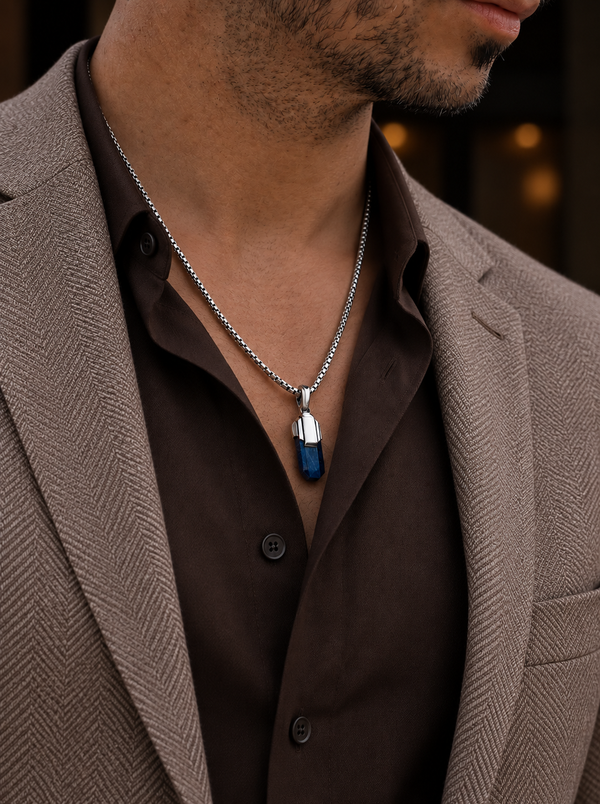
Box chain and rope chain are the two most practical options for wearing 2 pendants on one chain. Their structural properties keep pendants from spinning freely or travelling along the chain during movement. Thin cable chains below 2mm are best avoided entirely when adding a second pendant, as the links flex too much to hold both pieces in a stable position throughout the day.
For a full breakdown of chain types, weights, and how to choose the right length for your build, read our men's chain layering guide.
How to Pair Two Pendants That Work Together
Not every combination of pendants works well on the same chain. The most common pairing mistake is choosing two pieces that are too similar in size, weight, and visual prominence. When both pendants compete equally for attention, neither one stands out clearly, and the overall look reads as cluttered rather than layered.
Size and Weight: The Anchor and Accent Rule
The single most effective rule when wearing two pendants on one chain is to use one anchor pendant and one accent pendant. The anchor is the more prominent piece: larger, heavier, or more visually complex. The accent is the supporting piece: smaller, lighter, or simpler in design. This pairing gives the eye a clear focal point and a secondary detail rather than two competing centres that cancel each other out.
As a practical example from the NineTwoFive range: the Jamil (solid plain silver, 8g, architectural minimal) works well as the accent alongside the Tahsin (Art Deco stone-set, 6g, layered geometric) as the anchor. The Jamil's clean surface lets the Tahsin's stone and structure read clearly as the dominant piece without either fighting for space.
Matching Design Language Across Both Pendants
Beyond size and weight, both pendants need to share a design language to read as intentional rather than accidental. Two architectural geometric pendants in the same finish will always read as a deliberate pairing. A minimal silver bar alongside an ornate engraved circular disc in different finishes reads as two items that happened to end up on the same chain.
The practical rule: match the surface finish across both pendants - both polished, both matte, or both brushed - and keep the design vocabulary consistent. Mixing minimal with ornate, or flat with three-dimensional, produces results that look unplanned rather than chosen, regardless of how individually good each pendant is.
Shop now: Men's Silver Pendants

How to Prevent Tangling When Wearing Two Pendants on One Chain
Tangling is the most common practical problem when wearing multiple pendants on one chain, and it almost always comes from the same set of causes. Understanding what drives it makes prevention straightforward.
Tangling happens when the pendants are too close together on the chain, when they are the same weight and spin freely into each other, or when the chain is too thin and flexible to hold both pieces in a stable position. The most effective fix is spacing: keep at least 5cm between the two pendants on the chain, position the heavier piece lower so gravity provides natural separation, and use a chain with rigid or semi-rigid links such as a box chain or rope chain.
When storing the necklace, keep the chain flat rather than coiled tightly at the clasp, which is where most tangles begin. If the pendants tangle during wear, hold the lower pendant still, give the chain a light upward shake from the top, and the pieces will return to their natural separated positions without needing to be removed and reset.
For more on keeping your chain in good condition over time, including how to clean it safely at home, read our guide on how to clean a silver chain.
When to Wear Two Pendants on One Chain: Occasion Guide
Two pendants on one chain works across several contexts for men, but it does not suit all of them equally. The occasion guide matters here because the environments men typically dress for have specific expectations around visual restraint, and the number of visible pendants contributes to that reading whether you intend it to or not.

The consistent pattern: casual and smart casual contexts give the most room for wearing 2 pendants on one chain; office contexts work when the design is understated; formal settings are better served by one pendant or none at all. The size and finish of the pendants matter as much as the count - two slim architectural pendants in polished silver read very differently in a business context than two bold statement pieces.
Common Mistakes When Wearing 2 Pendants on One Chain
Most mistakes when wearing 2 pendants on one chain come from applying general layering logic to a single-chain setup without adjusting for the specific constraints involved. The three most common errors are also the most preventable.
Two Pendants of Equal Size and Weight
When both pendants are the same size and visual weight, neither one reads as the focal point. The look becomes a visual draw rather than a composition, which is the opposite of what layering is intended to achieve. The fix is to designate one as the anchor and choose the second specifically to support it, not to match or compete with it.
Chain Too Thin for the Combined Weight
A 1.5mm cable chain under two 8g pendants will kink at the clasp point, distort the visual line, and weaken at the links over time under the additional weight. Two pendants means double the load at the same attachment point. The fix is to use a chain of at least 3mm in a structured link style, such as a box chain or rope chain, that distributes the pendant weight more evenly along its length.
Mismatched Finish Across Both Pendants
A high-polish pendant alongside a matte-finish piece in the same look reads as two items that were not chosen together. Finish mismatch is more visually disruptive than a size difference because it signals that the combination was not intentional. The fix is to confirm the surface finish of both pendants matches before combining them on one chain, which is the single fastest way to make any two-pendant combination look considered.
For more on current men's silver jewellery styling, including how chain layering fits into broader trends, read our guide on men's silver jewellery trends.

Frequently Asked Questions
Can you wear two pendants on one chain?
Can you wear two pendants on one chain? Yes. It works well when the pendants are staggered at different heights with 5 to 10cm of space between them, the chain is a structured style such as a box or rope chain, and one pendant acts as the focal point while the other supports it. The approach requires one clasp and creates a cleaner look than two separate chains for most men.
How do you wear multiple pendants on one chain without tangling?
Use the stagger method: position the lighter pendant higher on the chain and the heavier pendant lower, leaving at least 5cm of chain between them. The weight difference naturally keeps the pieces separated during movement. Use a box chain or rope chain rather than a thin cable chain, as structured links prevent the pendants from spinning and wrapping around each other.
How far apart should two pendants be on a chain?
Five to ten centimetres is the practical range for most men's pendant combinations. Less than 5cm and the pendants will overlap during movement; more than 10cm and the pairing begins to read as two separate pieces rather than a considered combination. The exact spacing depends on the size and weight of each pendant: larger pendants need more space than smaller ones.
Can I put two pendants on a box chain?
Yes. A box chain is one of the best chain types for wearing two pendants because its rigid link structure holds both pieces in position without allowing them to spin or travel along the chain. A box chain of 3 to 4mm width provides enough structural support for most pendant combinations without looking too heavy for everyday wear.
What is the best method for wearing 2 pendants on one chain?
The stagger method is the best approach for most men's daily wear. Slide one pendant onto the chain at the midpoint and the second closer to the clasp end, leaving 5 to 10cm between them. Position the smaller or lighter piece higher and the larger or heavier piece lower. This requires no additional tools, maintains itself throughout the day, and produces a clean vertical line.
How many pendants can you wear on one chain?
Two is the practical limit for most daily wear situations. Three pendants on one chain is possible with the stagger method but requires a heavier chain and careful attention to spacing to avoid a cluttered look. Beyond three, the visual weight becomes difficult to balance and the combination generally reads as too busy for most men's everyday contexts.
Do two pendants on one chain look good on men?
Yes, when the combination follows the anchor-and-accent rule, uses a structured chain, and matches the finish across both pieces. The look works particularly well in casual and smart casual settings. It reads as deliberate and personal rather than heavy or overdone when the pairing has been chosen with a clear visual logic behind it.
Which chain is best for wearing two pendants?
A box chain of 3 to 4mm width is the most practical option for wearing two pendants. Its rigid links hold both pieces in a stable position throughout the day and prevent tangling. A rope chain in a similar width is also a good choice. Avoid thin cable chains below 2mm, which lack the structural integrity to support two pendants comfortably over time.
Two Pendants, One Chain, One Clear Rule
Wearing 2 pendants on one chain is a practical and considered approach for men who want more from a single piece of jewellery. The stagger method, a structured chain, and the anchor-plus-accent rule resolve the problems that make layering look unintentional. Start with two pieces that share a finish and a design language, and the result reads as deliberately chosen rather than assembled by chance.
To find the right chain length before adding a second pendant, use our men's chain size chart.
Shop now: Men's Silver Chains